Showing posts with label The Magnificent Seven. Show all posts

Monday, February 14, 2011

The Magnificent Seven, No. 4 - The Magnificent Seven Ride (1972)


The western underwent a brief but vibrant revisionist period in the early to mid ‘70s, just before a lengthy hibernation period. “The western is dead,” these movies proclaimed, “long live the western!” This is a time when even the mighty Spaghetti Western was on its Italian way out, and those which remained questioned their forebears.

A brief detour (already?!): Westerns traditionally are defined by a very narrow setting, the untamed American West. Amongst film genres, this is perhaps the most limiting. With increasing distance from the historic setting, there is less and less relevance in the western as historical fiction. Its codes have been adopted by other forms, with many modern action films utilizing old western language – it’s what it evolved into. I’m thinking e.g. of Die Hard. In fact, as the western loses its historical importance, it gains tonal importance, becoming closer to forms like comedy, drama, etc. Codes remain, notions of freedom, heroism, honor, lawlessness, violence, applicable to any story in a frontier setting, up to and including outer space. Hence No Country for Old Men is a western, in a contemporary setting; looking backwards, the old Kurosawa samurai epics are westerns, though they predate that era.

Anyway, back to the ‘70s. In the death spasms of the traditional western, a great number of revisionist efforts pulled the form this way and that: McCabe & Mrs. Miller, Jeremiah Johnson, High Plains Drifter, Pat Garrett and Billy the Kid, El Topo, so very many more. This was the environment of the final Magnificent Seven sequel, The Magnificent Seven Ride!, part of a series that was always more classical than revisionist. Such an effort would be even more anachronistic in 1972 than Guns of the Magnificent Seven was in 1969. For this reason it is a good thing Ride! appears in a minor revisionist mode, consciously closing the book on the Magnificent Seven saga by questioning many of that franchise’s rules.

One awkward through-line in all the Magnificent Sevens is the question of “Why do they fight?” This has grown increasingly overt in the sequels. Rather than continue to plug in that shoehorned notion, Ride! changes the mode of inquiry: “What if they didn’t fight?”


As ever, the connective tissue which makes Ride! part of a series are as following: Elmer Bernstein’s eternally kickass score, the number 7, and gunslinger Chris Adams. Once again, Chris is recast, now played by verifiable legend Lee Van Cleef – second only to Clint Eastwood, another veteran of The Good, the Bad and the Ugly just as Eli Wallach was in the first Magnificent Seven. Due to thoroughly unclear contract stipulations, Van Cleef here plays a role originated by Yul Brynner, while Brynner takes Van Cleef’s headlining role in the second of the Sabata trilogy, Adiós, Sabata.

It’s tough to think of Van Cleef’s “Chris” as Brynner’s “Chris,” so it helps just to think of him as his own man. It’s not like the series ever made him more than an enigma anyway, a leader three times over of seven-man posses. That history is enough to inform Van Cleef’s version, an older Chris anxious to forget his adventurous past. Retirement for such a roustabout involves acting as U.S. Marshall in an Arizona frontier town, and enjoying honest-to-goodness marriage to his wife Arilla (Mariette Hartley, from TV). And when Chris’ former friend (whom we’ve never seen before) Jim Mackay (Ralph Waite, from TV) arrives with a request that Chris join him to defend a Mexican border village under attack by a renegade band of 50 banditos…Chris refuses. Good thing, too, since there would be absolutely zero series variation had he gone.

This may be called The Magnificent Seven, but the first half is almost completely devoted to Chris alone. As a reticent frontier legend in his autumn years, Chris enjoys the company of a biographer named Noah Forbes (Michael Callan, from TV). This is a familiar revisionist tactic, a self-conscious examination of myth, so well utilized in Unforgiven. And under the corrective gaze of Mrs. Adams (i.e. Arilla), Chris hopes to uncharacteristically embrace the beatific halls of nonviolence. To this end, he releases 18-year-old robber Shelley Donavan (Ron Stein, from TV). This turns out to be a mistake, as Shelley “celebrates” his release by seriously wounding Chris, robbing a bank, and running off with Arilla. How many other movies can you name that are this quick in condemning nonviolence?!

Chris rides out to capture Shelley, accompanied by Noah. This major plot thread, which has nothing directly to do with the standard “Seven” setup, is a result of the greater thought process which caused Chris to reject his latest adventure in the first place. Things are about to get much worse for Chris. They find (well, Noah finds) Arilla raped and murdered, in that order, early along Shelley’s trail. Now it’s a revenge flick! Chris, violating all Noah’s ill-conceived notions of honor, tracks down Shelley’s partners-in-rape – which includes a frighteningly young, shaggy, be-mulleted Gary Busey. Chris learns where Shelley has gone…then kills them! In cold blood! No one does that like Van Cleef.
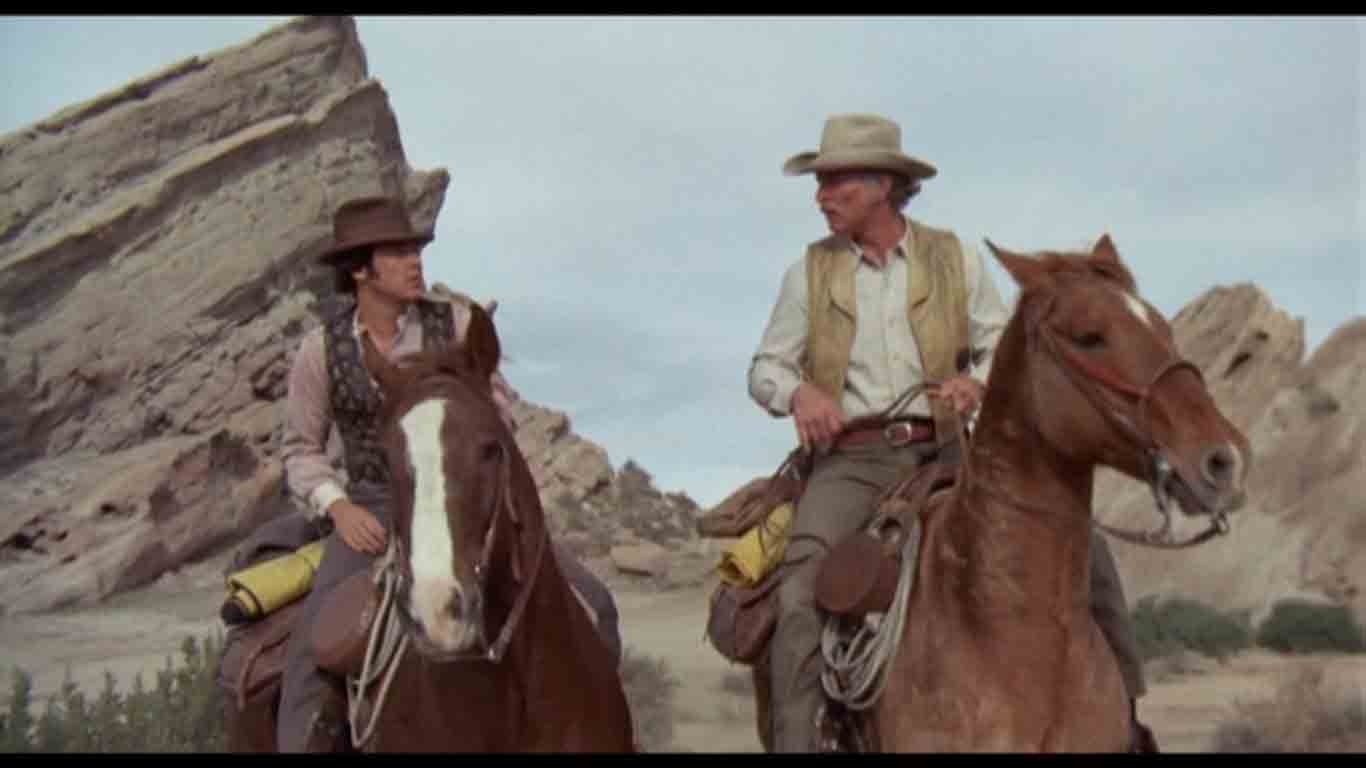

The trail leads the duo (a duo?! In a Magnificent Seven?!) along past Kirk’s Rock to “Mexico,” where Jim and the men of Magdalena (Jim’s town) ready an ambush for the bandits. Ah hah, the old thread returns! Shelley has joined this bandit band, headed by the dreaded and forever unseen Juan De Toro. Chris advises Jim that, without Chris’ help, their potential ambush is instead a suicide mission. And still Chris refuses to aid Jim, considering it fruitless in this predicament, and rides on in hopes to somehow find Shelley some other way.

Gunfire quickly brings Chris and Noah back to the sight of Jim’s ambush, which has itself been ambushed, Shelley specifically having sold these men out to De Toro. All this death, all a result of Chris’ decisions so far. That’s not all! Shelley is dead at Jim’s hands, and vice versa. So even the potential for Chris’ selfish revenge is gone.


Chris doesn’t learn this immediately, as instead he first travels to Magdalena to search for the missing Jim. Instead he finds the town ravaged by De Toro’s forces, which have already moved on to spread their message of thoughtless violence and cruelty to Texas – which could surely benefit from it. In De Toro’s wake are the town’s women and children, and hints (first subtle, then…er, less so) indicates that the former were raped – 17 women to 40 or 50 Mexicans. That is to say, repeatedly. And what’s amazing is this isn’t even among the more nihilistic of revisionist westerns!


Chris starts a relationship of mutual recovery with Laurie Gunn (Stefanie Powers, from TV), newly a widow just as Chris is newly a widower. To leap ahead a tad, it’s not surprising that romance springs up between these two. What is surprising is how inevitable and necessary this romance is, because Chris’ story has gone from one of apathy to revenge and now to redemption. Which is a lot of work to justify Chris’ actions in the second half of the story, but it gives the eventual climax far more context than Guns of the Magnificent Seven could ever wish for.

Even with De Toro et al long gone, their return is nigh, as De Toro intends a second rape spree as he returns from violently decimating Texas. In other words, Magdalena needs defense even now, after Chris has failed to defend it. Intent to do them right by any means necessary, Chris (and Noah) heads out collect five more men, to together create the titularly-necessitated seven.

I’d expended much effort up ‘til now incorrectly trying to identify the eventual Seven. Well, when the Seven do appear, they’re mostly entirely new, whom we’ve never seen before. For The Magnificent Seven Ride! “borrows” ideas from The Dirty Dozen (itself a variation on The Magnificent Seven), namely that the gunmen are culled from the local prison population. This is a sudden dump of heroes, but we must forego the traditional recruitment montage in favor of a stronger storyline for Chris.


With that in light, there isn’t humongous effort put into distinguishing these five newbies…though their little character moments still make them as distinct as those in Guns. It’s okay, since they’re in essence a group character, five prisoners allied against Chris. In answer to the eternal question “Why do they fight?,” Ride! suggests these warriors have little choice. Chris promises his team parole should they succeed, in true Dirty Dozen fashion. And should Chris die beforehand – that is, should they kill Chris in retaliation for imprisoning them – then, well, no parole! That still leaves open the question of what they’ll do once in Mexico, where they’d be free of the U.S. penal system, but we’ll get to that. Chris assures us (through Noah) that it’s under control.

Meanwhile, I guess we’d best give the five a cursory glance…Hmm, we got Pepe Carral (Pedro Armendariz Jr., from TV), Walt Drummond (William Lucking, from TV), Captain Andy Hayes (James Sikking, from, yup), Scott Elliott (Ed Lauter, from TV), and Mark Skinner (Luke Askew, from…well I’ll be, Easy Rider).

The idea now is for these men to secure and defend Magdalena from the inevitable incursion of rape-hungry banditos. Because this is an action movie, there must be a simpler early mission to attend to, and verily Chris has arranged one. With De Toro off spreading his Mexican apocalypse throughout the Lone Star State, Chris et al descend upon De Toro’s lightly-guarded headquarters, for weapons. And at this stage, Ride! marks itself out as a surprisingly thoughtful franchise closer, exclamation point excepted. In marked contrast to Guns, Ride!’s warriors do not simply ride in without hesitation. Rather, they carefully plan their assault, working out tactics with a forethought not oft seen with murderous bounty hunter types. What follows is a pretty good shootout, all things told, with certain caveats to be covered at the end.


The battle concludes with Chris ensuring his men’s loyalty, no matter what. He steals the real prize, De Toro’s unnamed woman, and sends a single messenger off to tell De Toro that he and his assorted associates have taken her back to Magdalena for a characteristic and systematic raping. Chris isn’t that cold, of course, but it guarantees his prisoners’ allegiance, as the only way to escape De Toro’s wrath in Mexico is to kill De Toro. Very clever of Chris, very clever in general, this is a much more thoughtful Seven than most. I like this movie!


With a surprising minimum of plot arbitration, we’re now at the expected Magnificent Seven scenario: Seven guys defending a helpless town from invasion. Even at this late stage, The Magnificent Seven Ride! distinguishes itself from the lesser sequels by being surprisingly smart about it. Strategy again becomes the central focus, second only to Seven Samurai itself. The Seven work out a specific, detailed ambush involving several outer trenches, traps, explosives, and rifles of assorted ranges. Actually, this nicely answers one question even the mighty Magnificent Seven avoided: How does one adapt the Seven Samurai defensive strategy to gun warfare?

The limited running time is nearing an end. Yet even with the scramble to fortify Magdalena, there’s time for genuinely involving character scenes, as the Seven and the town’s women all make heartfelt connections, each of them damaged and broken and tired by their difficult lives. Credit for this goes to screenwriter Arthur Rowe (from TV), who thoughtfully provides the Magnificent Seven deliverables with a lot of unexpected meat.

Credit, however, probably does not lie with director George McCowan (ditto from TV), and here we come to my major caveat. Consider the background of nearly every member of the film, excepting the omnipotent Van Cleef…That’s right, The Magnificent Seven Ride! has all the earmarks of a made-for-TV movie, including budget-conscious off-the-shelf western sets, an overdependence upon Vasquez Rocks, and a distractingly static camera. The end result is eons better than most television movies, in terms of sheer spectacle, and that’s including the best examples of that defunct format, such as Duel or Brian’s Song or The Day After. Given the progressive devolution of quality with former Magnificent Seven sequels, this is a necessary budgetary fallout.

Actually, considering how horribly crippled The Magnificent Seven Ride! was in its mere conception, an unwanted third sequel to an outdated western remake of a Japanese art house effort, it is far better than it has any right to be. Perhaps with those lowered expectations, it had the freedom to move away from the “sequel as remake” trap the other sequel Sevens succumbed to. At any rate, Ride! is a respectful follow-up, actively deconstructing and reconstructing the formula and delivering some mighty fun western action. If you have the capacity to forgive some less-than-stellar technical merits, The Magnificent Seven Ride! has a lot to offer.


Thus did the Magnificent Seven film franchise come to a close in 1972, somewhat parallel to the western genre as a whole. But recall how unlikely it is for a western to have three sequels to begin with, in the non-sequelizing climate of cinematic oaters. Most western serialization belongs to television, and did even prior to The Magnificent Seven. So it’s no great surprise that what little life was left in the Magnificent Seven name found its outlet on television.

The Magnificent Seven” aired on CBS – ah, so that’s why I’ve never heard of it! It was a Michael Biehn vehicle, and really he’s not a bad choice to play a leader of divergent badasses (see also Aliens). Being a TV show, “The Magnificent Seven” told mostly isolated adventures, like the old “Gunsmoke” and “Rawhide.” The classic story of the seven ridding a town of bandits is reduced to the two-part pilot, which is a shame when one considers how a newer TV show might stretch that notion out into an entire season – as length and patience benefits Seven Samurai, so might it in this format. It wasn’t to be, though, and “The Magnificent Seven” ran it its serialized form for two seasons, from 1998 to 2000.

This evidently concludes the legacy of The Magnificent Seven. But it was just one of many movies owing their existence to Seven Samurai. Appropriately, seven more official remakes await us (many unfindable and thus unwatchable), and we shall see just how malleable this “men defend village” concept really is.


RELATED POSTS:
• No. 1 The Magnificent Seven (1960)
• No. 3 Guns of the Magnificent Seven (1969)

The Magnificent Seven, No. 3 - Guns of the Magnificent Seven (1969)


Westerns don’t normally have sequels, at least ignoring the pre-Stagecoach matinee franchises like The Three Mesquiteers and The Range Busters. Why is that? Most end with some adventurer riding into the sunset, promising to defend all those in need. That seems like the perfect framework for many more isolated struggles to come. Perhaps the western’s status as a morality play prevents that, as continuation can destroy the perfect whole of such a symbolic narrative. And maybe it’s also because westerns were being “sequelized,” in a sense, but on TV series like “Rawhide” and “Branded” and lookie here, Wikipedia lists a full 174 TV westerns!

This was the state of things for most westerns in the ‘50s and ‘60s, no matter how popular. Besides, it’s easier to simply brand someone like John Wayne, without the label of “franchise,” as John Ford famously did. Amongst the classical westerns (that is, pre-Spaghetti), The Magnificent Seven is the only one I know of with any sequels…it has three. This is perhaps because it jumpstarted a new action subgenre, even as it delivered classic western tropes. The ensemble “man on a mission” movie grew up from The Magnificent Seven, often numerically upping the ante: Ocean’s Eleven, The Dirty Dozen, One Hundred and One Dalmatians…okay, not the last one. And when subgenres emerge, often the codifier work creates follow-ups, to compete with its offspring.

Director John Sturges did just that, in 1963, with The Great Escape, a riveting WWII entertainment which brings back a huge percentage of The Magnificent Seven’s cast – Steve McQueen, Charles Bronson, James Coburn.


That wasn’t a sequel…not by any standards. That, instead, came out in 1966, as Return of the Seven. Never mind most of the cast, including most of the valuable cast, died in the first, you can’t call it Return of the Last Two Guys. Besides, while Yul Brynner stayed on as the lead, Chris Adams, costar Steve McQueen wanted no part in this project. Rumors vary as to why, if McQueen hated the script, or hated Brynner, or if he was just too awesome now on the eve of Bullitt and The Thomas Crown Affair. At any rate, McQueen’s Vin is recast, now Robert Fuller.

Actually, everyone who’s not Brynner is recast, including that other surviving “Seven,” Chico. (Geez, that sounds like a Marx Bros. sentence!) We’re also Sturgesless, Burt Kennedy fulfilling the role of director with mere passable competence, nothing more (to look at his resume of middling westerns). Not that I can say with certainty, for Return of the Seven’s reputation is apparently dire enough for it to join this blog’s ignominious ranks of “unwatched” movies.

Either way, the story sounds like purest sequel hokum – You know, awkwardly rejigger the end of Part One so as to allow the same exact story to happen again. This means the same Mexican village is beset upon by different bandits, now numbering 50 (escalation!), and Chico is captured with them, to be put into slave labor. Ah, but he escapes, as he, Chris and Vin get about recruiting four new gunmen, almost entirely because the number seven is titularly important, and they’re apparently doomed to run through this narrative time and again.

It’ll take a viewing of the second sequel, Guns of the Magnificent Seven, to determine if that’s truly the case…


Well…it is and it isn’t. Explicit, idiotic continuity like the exact same village are gone, as Guns apparently does the common Part Three thing of correcting for the first sequel’s formula miscalculations. See also Indiana Jones and the Last Crusade and Die Hard with a Vengeance, for recycling the right traits Part Two forgot. Of course, Guns of the Magnificent Seven still subscribes to the endless notion of “sequels as in-continuity remakes,” which makes this, unofficially, a bastardized, third generation remake of Seven Samurai, whether it even knows that. For the central plot thread remains e’er the same: Seven warriors amass to fight for the poor and impoverished. The exact same recruitment sequence follows, only with a new batch of seven (just as in Part Two), justifying the stylistic repetition.

So many steps removed from the original, Japanese version which had a point, much of the fundamental humanity of the Seven’s quest gets lost. There are attempts at drama, but such attempts feel shoehorned in out of necessity. The real interest of Guns is simple formula experimentation, to see how, structurally, things change with variation.

Most significantly is the Seven’s quest, which is not defense as in Seven Samurai or The Magnificent Seven (I cannot speak for Return of the Seven), but offense: To break into a maximum security prison and rescue a high profile prisoner. Yes, now the Magnificent Seven franchise is aping its apers (that glorious ouroboros one finds with subgenres), retelling the Where Eagles Dare story in the Mexican Revolution.


Yes, so very many westerns invoke the Mexican Revolution, a transparent guise to add on some pap about “freedom” and “the people” and whatnot. Partly, this is because that lends a western an “epic” feel when simple cowpokes vs. homesteaders won’t do. More likely, it’s because a great many Spaghetti Westerns (i.e. Italian westerns, and yes, those are often the best sort) were filmed in Spain, and the Spaniards look like Mexicans if you squint hard enough (as Clint Eastwood is wont to do). Guns, though a Hollywood production, utilizes the Spanish deserts (as did Part Two), making it something of a Spaghetti Western.

Tonally, Guns seems desirous to take on the pulpy, exaggerated contours of a Spaghetti Western (I’m thinkin’ more Django than For a Few Dollars More), which doesn’t jibe well with that classical Hollywood western feel Guns inherits from its own Magnificent Seven. By 1969 standards, Guns feels somewhat anachronistic, like an old guard relic struggling to remain relevant. Add to that the simultaneous explosion of darker, post-classical Hollywood westerns, epitomized by Sam Peckinpah’s The Wild Bunch. The western was becoming as dark and cynical as most cinema moving into the ‘70s, and Guns can only make a token show of following that trend.


Not that it’d completely work even in the classical mode, assuming somehow this was put out in ‘60 instead of ’69 (that is, if this were to replace The Magnificent Seven). The cast, the entire cast is new, not even Yul Brynner remaining. Oh, Chris Adams remains, for we need something to keep this specifically within the franchise, and not just Generic Western With, Coincidentally Enough, Seven Guys. Leading an emaciated macho cast, late enough in the game that no major stars are interested in the genre, is George Kennedy – the only instantly recognizable face. Paradoxically, I know him best as the strapping, ridiculously muscular beast in Cool Hand Luke, and the fat, aging, put-upon police captain in The Naked Gun. Neither of which really gives Kennedy the necessary iconography to play Chris. Besides, the man is literally a redneck, as the picture attests.

And now…the rest of the Seven:

Second-in-command: Keno (Monte Markham, TV star – that’s how far we’ve fallen), a horse thief. Actually, this late in the “men on a mission” cycle, there’s no longer a point in giving your team personalities, per say. Instead, they all have “specialties,” novelty forms of machismo which combine together once the job is underway. Keno, thus, is defined completely by that “horse thief” title, which doesn’t ultimately amount to much. So like many a second-in-command, the ostensibly important Keno is rarely ever around.

The young, naïve one: Maximiliano O’Leary (Reni Santoni, most famous as a minor character from Dirty Harry). Because it’s so hard rounding out a complete seven each time, Max actually fulfills the standard “villager” role – the man who hires gunmen to do his dirty work. He’s added to Chris’ team, why the hell not, under the bizarre notion that they just gotta have seven guys, simply because series rules dictate so. As the sequels go on, this really starts to feel arbitrary and awkward.


The old one, coming back for “one final big score”: James Whitmore as Levi. He also happens to be the knife specialist. Hey, guys, don’t load up all your novelty traits onto one guy!

Explosives: Cassie (Bernie Casey). I hate it when characters are (almost) named after their actors. In what half-way qualifies as progressive by 1969 standards, Cassie is the first non-white to join the Seven – though honestly nowadays we’d expect a little diversity in our teams, excepting the all-Jew Basterds. Being black is apparently enough of a “personality” for Cassie. Oh, and guess which one dies first! Yup, the cliché is healthy and strong in this ancient production.

Actually, they handle Cassie’s minority status with remarkable tactlessness. Being black is directly equated with being deformed, disabled, an “other.” That’s because Cassie is paired up with an actual cripple, the one-armed trick shot artist. That’d be Slater (Joe Don Baker, who I do recognize – by name at least – for playing a fat, fat man in three separate Bond films…when your “macho” cast is famous for being fat, you know you’re in trouble).

Then there’s the “other one,” P.J. (Scott Thomas), whose entire personality is “wears a black outfit.” By some less informed notions of the western, I guess they thought it was revolutionary to put a good guy in black, then give him the desultory romantic subplot I’m not going to address further. They ought to have tried harder.


The specifics of the Seven’s task: Free one Quintero from the vile Colonel Diego, in the strongest Federale prison in all of Mexico. Quintero can then, presumably, lead his rebel forces to victory, something he’d clearly not been able to do prior to his opening capture. Look, just go with it, there’s a prison to be broken into, a pretty classic “heist” style setup, so let’s just concern ourselves with the logistics, shall we.

A good movie of this sort would commence with a lengthy “scoping it out” section, detailing the intricate, unstoppable defenses of the prison, setting up specific mini-tasks for the Seven to overcome, you know the drill. I’m thinking of an Ocean’s Eleven sort of scenario, though today it’s easiest to refer to how Inception did it (minus, of course, the dream thing). This seems to be beyond the powers of lowly director Paul Wendkos, whose fame comes from directing the Gidget movies. Oh boy!

No, the “scoping it out” routine is boiled down simply to Chris wandering on up to the prison, and outright asking a guard about its defenses. And the guard tells him! Then Chris strolls away again, successful only because he is white, and therefore apparently trustworthy. Boy, that was anticlimactic.


Instead, the lengthy, draggy remainder of the Second Act must tread water as the Seven interact with various revolutionaries, have assorted go-nowhere character scenes, and otherwise waste time. Of note, perhaps, is how Guns attempts to create drama 1/100th of what The Magnificent Seven put out, which was itself maybe 1/20th of Seven Samurai’s output. For here the series-old question of “Why did they pick this job?” isn’t just outright stated (as in Magnificent Seven), but even answered. That’s some poor dramatics there, as it removes all meaty ambiguity from your project. Instead, Chris simply announces he did it initially for the money (a whopping $100, up 5x from The Magnificent Seven’s reward), but now doesn’t want the money because he loves the rebels. This is that whole weird American western obsession with celebrating the Mexican Revolution, without ever invoking its messy politics. Chris pretty much gets the Han Solo arc, only played in crayon, and with no Wookies.


That nonsense out of the way, the Seven can proceed with their assault upon the prison, preplanning or no. Let me sum up their strategy in a nutshell first, then get into details…

Just a full-on, balls-out attack!...By seven guys…

That is why there was no careful planning section, there was no careful planning. There’s a little bit of a preliminary involving the Seven sneaking into train carts so they can get close to the prison, which we’ve already seen is completely not a problem for them, so this is just filler. And even when they get to the prison, any need for cleverness is negated by the fact that they suddenly have a whole bunch of expendable Mexicans to do their dirty work. I think there might be a little unacknowledged racism at play in this movie.

A tactless assault is appropriate for a western, and I even excused similar tactics at the climax of The Magnificent Seven. But it’s usually just so disengaging for an audience, since they know the good guys must win by default. No need for subtleties; if you’re the hero, just do whatever you damn well please, and it’ll work out. I mean, sure, many of the Seven do die in this moronic effort – I hope it was worth it for $100! Actually, the same four die as have in all previous versions of this story. That is, survival is limited to Chris (to carry on the franchise), the naïve one (to justify his growth arc), and the other one with an identifiable arc (in this case, Levi of all people – because he has a family to go back to). As far as sequels go, this degree of regimentation severely limits tension, forcing us to focus upon the little details instead.

Anyway, of those details, for that’s the one place where Guns might now distinguish itself… In keeping with its contemporary Wild Bunch, use of a ridiculously big machine gun figures prominently into this chaotic melee. Now, The Wild Bunch is a fantastically violent picture, playing its gunplay up for maximum carnage, and using a very Kurosawa slow motion. It’s a critique upon the thoughtless, bloodless, easy butchery in classical westerns. Now, Guns pretty much resembles what The Wild Bunch was railing against. Little of what transpires here has any impact, beyond a shrugged off “Oh, well, I guess that guy’s dead now, eh.” Actually, that goes for all the violence in Guns of the Magnificent Seven, which is plentiful (most of it comes courtesy of the strangely kill-happy Colonel, whom they’re struggling to paint as an irredeemable monster when he just seems an overzealous, under-effective bad guy).

And of course the cavalry of revolutionaries arrives once the majority of the climax has passed, to break into the prison on their own, meaning…there was no point in the Seven doing any of this! And it’s not the Seven Samurai ending, an intentional dramatization of pointlessness. It’s actually pointless!


Chris bids the rebels farewell, because the genre (and franchise) dictate precisely how these things must end. Because everything thus far in this Seven cycle includes a capper quote, here’s George Kennedy’s:

“The cowards die many deaths. The brave only one.”

I think I saw that in a fortune cookie once.

Then our “heroes” ride off into the sunset, and it’s a sign of how underperforming Guns is that they can’t even successfully deliver this classic image. Otherwise, I would’ve capped it, instead of showing George Kennedy’s sunburned mug again.

Guns of the Magnificent Seven delivers lowered thrills. It’s clear this thing played to more specialized audiences than the universally loved Magnificent Seven. Indeed, the western as a whole was undergoing substantial changes in 1969. Newly lifted restrictions allowed violence and cynicism to, which was actually (contrary to popular opinion) already pretty danged cynical in the celebrated John Ford mode (I mean, what you seen The Searchers lately?). Actually, the whole late history of the western seems like a continual effort to undercut the presumed wholesomeness and contradictions of the classical-style westerns. No matter its wishes, Guns of the Magnificent Seven plays in the antiquated mode. With hindsight, it’s obvious now there was no more room for that, that the western of the ‘70s would be dominated by bleaker Clint Eastwood-directed efforts, ceding the popular box office it enjoyed once.

The death of the western is actually a fascinating subject to me, as it’s one of the few “major” genres which seem so cyclical (the other being the musical). Is it even a genre, like action or horror or comedy? Likely not, as a “western” demands a specific time and place. It is a contextual genre, not a tonal genre. That is, it’s free to mix with setting-independent styles, to be a drama, tragedy, thriller, you name it. Most post-modern westerns are about the western as a movement, and that includes the rare modern holdouts like the Coens’ recent True Grit and No Country for Old Men. Guns of the Magnificent Seven hardly fits into this broader late-stage discussion, except as an example of why the average western is no longer viable. But maybe I’m jumping the six shooter with this diatribe, for there’s one more Magnificent movie ahead, hailing from 1972…when things were far more dire.


RELATED POSTS:
• No. 1 The Magnificent Seven (1960)
• No. 4 The Magnificent Seven Ride! (1972)
(see also Seven Samurai)

The Magnificent Seven, No. 1 - The Magnificent Seven (1960)


Seven Samurai has inspired the most remakes of any film for many reasons…Because it is a simple but powerful story – Warriors defending a village from bandits. Because it is universal, and can be applied to any setting in any time. Overlooked, but maybe most important, because it was not made in Hollywood.

Even to this day, there is an assumption American audiences (which make up one of the largest markets for films worldwide) will not watch anything not originally made in their language. Subtitles are right out, and bad dubbing only barely passes muster. Seven Samurai opened up the notion of international cinema, but only to a gentrified class, which thankfully included filmmakers such as George Lucas and Steven Spielberg…and John Sturges. (Compare that to how the stateside distribution of the same year’s Godzilla…) To truly bring the Seven Samurai story to mainstream audiences, it would need to be remade in English, by Hollywood, with a Western viewpoint. Look to The Ring and The Grudge for how Japanese cinema continues to “enjoy” this treatment.

How does one make Seven Samurai Western? One makes it a western! This is not such a difficult thing, as Akira Kurosawa filmed his original in imitation of John Ford’s earlier westerns, notably Stagecoach. Rephrasing Seven Samurai as The Magnificent Seven, and turning these samurai-fashioned-as-gunslingers into regular old gunslingers, is a most natural thing.

The Magnificent Seven is a classic in its own right, taking full advantage of how flawlessly constructed Seven Samurai is. It helps having a tested Hollywood director, as John Sturges had already handled some classic and respected westerns such as Bad Day at Black Rock and Gunfight at the O.K. Corral. So the western background to Magnificent Seven is solid, allowing the Samurai influence to bump it near the top of the U.S. western pantheon, with a great cast, confident direction, and a proven blueprint.


One could stretch the Samurai/Magnificent comparison for the entire film, which is apt for how perfectly the plots parallel, as do many smaller details. Again, it’s a village plagued by bandits, which hires seven warriors to protect them. Only now it’s a Mexican village, Mexican banditos, and assorted gunmen standing in for ronin. The new setting creates some variation on tactics and such, what with pistols replacing swords and spears. More importantly, being an American movie, The Magnificent Seven streamlines the rich, full running time of Seven Samurai into something just slightly over half as long. The story is simple enough there is nothing lost in the translation, but this changeup loses the fundamental humanism and texture of Kurosawa’s piece. The Magnificent Seven retains some of Seven Samurai’s baser powers, standing as another monument to slowly-evolving cinematic badassery, but the plight of the village now never feels like much more than a justification for good ol’ gunslingin’ shenanigans.

Certain changes are for the better. Not that Seven Samurai needed a villain with a face, as its bandits were most effective as an “other,” but the Hollywood-style good vs. evil morality tale demands a personal enemy. So the movie’s greatest character, I’d argue, is the first we meet, with no parallel in the Japanese version: the leader of the bandits, Calvera (Eli fucking Wallach!). Calvera is no mere thoughtless villain, as he’s rather a mouthpiece for some of the themes regarding duty and action which the American screenwriters (assorted Walters with different last names) picked up on in Kurosawa. It is unsubtle to lampshade former subtext, lest wider family audiences not pick up on it. Yet Eli Wallach is such an awesomely talented actor, he sells any of the heavy stuff, and makes his Calvera a strangely human figure. There are small hints of his upcoming Tuco in The Good, the Bad and the Ugly, and it’s quite likely I’m letting thoughts of one of my favorite films ever color my impression upon (re)watching The Magnificent Seven. But if it makes this other movie seem better, no harm in it.

The cast as a whole is largely made up of familiar faces, future independent badasses here earning their badass credentials. This applies mostly to the gunslingers, whom our villager friends seek out in a nearby border town. It’s said Seven Samurai created the “men on a mission” subgenre of action, war movies filled with panoplies of manly men, movies like The Guns of Navarone and The Dirty Dozen. Truly, The Magnificent Seven is more immediately responsible for that evolution, as it took the impetus of Kurosawa’s film and let it loose in another culture. These types of films, ideally, showcase recognized actors in rare supporting roles. The Magnificent Seven accomplishes this mightily.


In any film with a group of heroes, the leader must be the pre-established thespian, the man whose baggage lends credence to the rest. It being 1960, that role goes to Yul Brynner as Chris Adams. His eclectic ‘50s career ranges from The King and I to The Ten Commandments, always in royal roles. Most importantly, he’s bald, which identifies him inarguably as the remake’s Kambei stand-in.

His introduction is somewhat similar to Kambei’s scene with the thief. In fact, there are many specific set pieces which reflect precursors in Seven Samurai. The Magnificent Seven doesn’t aim to recreate Seven Samurai quite as lavishly as certain other Kurosawa remakes [cough!] A Fistful of Dollars [cough!], instead borrowing moments here and there as it sees fit. This works best to give Magnificent Seven its own identity, as Chris’ introductory act of random heroism is its own thing, more in keeping with the western.

This involves delivering a dead Indian to Boot Hill, for a proper burial many of the town’s racist residents oppose. Actually, this scene serves double duty, introducing also the second of seven, Vin (Steve McQueen, future “King of Cool,” now just a promising young anti-hero with “Trackdown” and Never So Few to his credit). Let us credit Sturges, and this role, for catapulting McQueen into iconography. Let us, however, not try pinpointing a precise parallel for Vin in Seven Samurai…though if I had to pick one, I’d go with Shichirōji.

That’s a challenge of The Magnificent Seven, from the remake/franchise perspective. There are moments of inarguable Japanese-stolen inspiration, but other elements with no obvious antecedent. And still other elements which, for whatever reason, are otherwise altered. Take Horst Bucholz as Chico. He is actually an amalgamation of two Samurai characters, Katsushirō and Kikuchiyo (name-wise, I can see that getting confusing). This is odd, since those are arguably the two most interesting characters in Kurosawa’s epic, each naïve in his own way, but one a braggart commoner, the other an idealistic noble. There’s a certain thematic similarity to their function, in emphasizing class and heroism, but what’d I say about The Magnificent Seven highlighting thematic concerns? So in Chico we have the young buck who latches onto a team of gunmen, has a romance, has a character arc, all of that. It’s a shame Chico’s personality is compromised, leaving us with no one to run wild through the movie like Toshirō Mifune. That alone explains why Seven Samurai is the better film.

Running through the other four quickly…


James Coburn, eventually Derek Flint, is a taciturn, quick-minded knife specialist. He is recognizable as the ersatz Kyūzō, mostly because his introductory scene (a western-style showdown growing out of a minor dispute) is one of the pilfered set pieces. For all of Coburn’s own, personal awesomeness, his knife-throwing Britt isn’t quite as invaluable as Kyūzō.


One more uncontestable badass: Charles Bronson. (Which is his flagship future franchise? Death Wish.) Good luck finding a Samurai parallel for Bronson’s Bernardo O’Reilly (yet another role which challenges the actor’s ethnicity), for Bronson’s sheer Bronsonness overwhelms any other factors. He only really stands out once they reach the village, and Bernardo becomes the favored role model for a gaggle of young hero worshippers. Kikuchiyo enjoyed something similar, but that just confuses matters.

What with the doubling-up of parallels, and other remake-related confusion, that leaves at least one role open for a wholly original “seven.” Lee (Robert Vaughn – his series: “The Man from U.N.C.L.E.”) is an aged western wildman, who is starting to doubt his life of violence. This allows for a character arc of arguable cowardice. It’s a good notion, something that would’ve worked nicely in the lengthier runtime of Seven Samurai (we lose some character depth at 2 hours). As it stands, Lee is notable as another step in that genre-long western tradition of questioning its old archetypes. The worn-out old warhorse, the anti-hero, we’d see Sergio Leone and Sam Peckinpah run with these ideas later. Then we’d see Clint Eastwood completely shatter everything about this type in Unforgiven. Wish we could’ve seen more of Lee.

About the seventh, Harry Luck (Brad Dexter), I haven’t much to say. He seems a bit of a dandy, a “Maverick” type. He gets completely lost in the shuffle.


The Magnificent Seven spends, proportionally, much more time assembling its team than Seven Samurai did, since the film is nearly half complete once they’ve reached the village. The emphasis is clearly on the heroes as heroes, as the early American action hero starts to get defined throughout the ‘60s. Focus then moves away from the village, which is mostly just an ideal to be fought over here. The villagers lose the horrifying contradictions of Kurosawa’s peasants, which means when certain set pieces utilize them in the same way, it isn’t as effective.

So the Seven (“Magnificent” being a descriptor only the title insists upon) get the same fearful welcome as their samurai brethren. It plays out in a similar manner, with Chico acting Kikuchiyo (Kiku-chico!) and ringing the church bells. As in the original, this act gets him officially accepted into the group.

The Magnificent Seven is in a bit of a hurry relative to Seven Samurai when it comes to pitting its heroes against the bandits. There is a little preliminary effort put into fortifying the town, creating a rock wall, but not too much, for this is more “western” than “war.” There is enough time for character exploration before we get down to business. Chico gets the Katsushirō romance with a girl named Petra (Rosenda Monteros). This mostly follows the Kurosawa example, though more in the classic Hollywood romance style – that is, as a disposable subplot. This only becomes important at the end.


The Magnificent Seven is anxious to bring back Calvera’s men early, largely because they include Calvera, and what’s the point of creating an effective villain if you’re not going to use him. So whereas the samurai are entirely prepped once the bandits attack, here Calvera’s banditos simply ride on into town all of a sudden with no warning and no skirmish. This allows Calvera and Chris to have a lengthy showdown of words, outright addressing the question of why such gunmen help foreign peasants. That’s the most significant thing Seven Samurai left unspoken.

John Sturges stretches the tension of this scene, this friendly dinner table chat between Calvera and Chris, reasonably far. It stands as a precursor to later such scenes, like Angel Eyes’ intro in The Good, the Bad and the Ugly (that is not the Eli Wallach character), or that first half hour of Inglourious Basterds. And it ends in the only way such things can – SHOOTOUT!

It turns out the gunmen did have their defenses prepped, only theirs’ involved trapping the banditos inside the village first, en masse. Hence the fortifications (mostly volleyball-type nets) weren’t even visible yet. Having effectively ambushed Calvera’s men, the 7 effectively fight off the 40 (yup, it’s the same numbers), and a battle of wits starts up with Calvera.

Now, Seven Samurai was a siege story, essentially, which The Magnificent Seven never really attempts. While defense of the village remains a priority, this is a bit more of a roaming, region-wide battle, taking full advantage of those sweeping, powerful vistas the western is most known for. Despite occasional familiar scenarios, we’re moving well out of Kurosawa’s shadow, and heading well into SPOILER territory. The climactic events of The Magnificent Seven are something I maybe wouldn’t normally address, except for how they relate to the original. For without a single siege-like engagement having been fought, Calvera successfully captures the village!


This is a scenario the samurai never had to face. In their film, tension mounted even as bandits dwindled due to overall fatigue, and the steady wrath of nature. A Hollywood picture must create climactic tension via some other means, hence the bandits have their numbers and the advantage of position going into the home stretch. And the gunmen have their various character low points, just before impassioned speechifying resolves this. It’s Screenplay 101, the early Third Act lament, but I think it’s totally forgivable in a Hollywood refashioning of a foreign story. It shows just how sturdy the original Kurosawa framework is, that it fits other culture’s narrative formulae with such ease.

Enough of those concerns! The seven gunmen decide to take back the village in the only way understandable to a modern action mindset – through sheer show of force. Never mind they’re hopelessly outnumbered, the townsfolk held hostage, it’s only in this predicament where an action hero becomes truly dangerous. So forget issues of strategy or realism, for The Magnificent Seven is perhaps the last of the classical westerns even as it’s the first of the “men on a missions.” As such, all you need is guns-a-blazin’, some crowd-pleasing horse stunts, and victory is assured.


What’s amazing about The Magnificent Seven is that it is a classical western, with a classical western’s morality. Consider Elmer Berstein’s truly legendary soundtrack, which really does sum it all up. The Magnificent Seven has entered the realm of legend even while it is an openly indebted picture. As a movie of that type, its conclusion differs in certain ways from Kurosawa’s. Sure, following the Japanese model, the gunmen’s is a pyrrhic victory, with more dead than alive. But the true loss, in Kurosawa’s epic, was the zero sum gain for the surviving samurai, directionless and classless ronin at the end as at the start. It’s not quite possible to make the same statement with gunslingers, who were never remotely as codified as their samurai brethren. Not that there isn’t an effort at a closing line to echo Kambei’s:

“The old man was right. Only the farmers won. We lost. We always lose.”

That ignores the fact that they did win…or at least Chico did. Unlike Katsushirō, Chico has the option, and makes the choice, to stay in the village with his young love. Which was never really a long-term option for Katsushirō. This speaks of positive change and improvement, which is a distinctly American notion. While the other surviving gunmen (I won’t say which, and I hope the final pic doesn’t make it over-obvious) do ride off alone into the sunset (I mean, what else could happen?!), that’s more in the Shane sense of riding off to do more good, have more adventures…have sequels. This highlights the fundamental, philosophical difference between remake and original – not a bad thing, as it makes The Magnificent Seven its own beast, an act of cinematic reinterpretation which nicely compliments the original.


(P.S.: While The Magnificent Seven is a franchise unto itself, this movie also counts in a separate “franchise” as Seven Samurai No. 2. For ease of designation, that has been omitted from the post title, yet is still reflected in the tags.)


RELATED POSTS:
Seven Samurai (1954)
• No. 3 Guns of the Magnificent Seven (1969)
• No. 4 The Magnificent Seven Ride! (1972)
(see also Seven Samurai)

LinkWithin