Showing posts with label Dirty Harry. Show all posts

Wednesday, August 18, 2010

Dirty Harry, No. 5 - The Dead Pool (1988)


The best thing for a franchise (at least artistically) is to quit while it’s ahead. This can give the series a sense of closure, especially when the final entry is intentionally done with seriousness and maturity. Audiences can feel glad about the wrapped-up ending, feeling things have come full circle.

The Dirty Harry series had already had that particular entry – Sudden Impact.

But here comes The Dead Pool, the true final film in the Dirty Harry franchise, and going on 22 years (and one Clint Eastwood acting retirement) later, it seems it shall remain that way. For while artistic triumph is surely one way to end a series, The Dead Pool proposes the other common method – wear the premise thin through silliness.

The Dead Pool perhaps outclasses even The Enforcer as the goofiest, shortest and least consequential of the oft weighty Dirty Harry pictures. And by 1988, there really wasn’t much need for a Dirty Harry film, five years after the last one. The action movie landscape had undergone its final changes by then, changes largely instigated by the original Dirty Harry, becoming a playground for muscle-bound Austrian madmen with howitzers. So it is this realm of easy sequels (something Harry never really existed in before) that The Dead Pool is responding to, even while its contemporary Die Hard was proposing the next new direction for the action genre. All in all, The Dead Pool is something which must’ve seemed outdated even upon release.

And just why does this thing exist anyway? Well, director Clint Eastwood had a new movie prepped for Warner Brothers, a biopic on jazz saxophonist Charlie “Bird” Parker starring Forest Whitaker, called Bird (let it never be said Eastwood can avoid a good Hitchcock comparison, even at their most nebulous). Filmed in 1987, this unreleased film was not a major box office prospect for the studio. Clint was ever the master at turnaround, so he promised one silly entertainment in exchange for Bird. And in this climate of sequelitis, it’s easy enough for Warner Brothers to then, in February of 1988, dust off the Dirty Harry movies, declare they shall be getting their sequel, and then spew one out upon us a mere five months later.

After a great director (Don Siegel), two okay directors (the next two guys), and one of cinema history’s best ever (Clint Eastwood), who’d they go with this time? Buddy Van Horn, Clint Eastwood’s stunt coordinator…Okay then. You’d think there’d be more stunts, then, considering… The three credited screenwriters are equally anonymous, so there.


All this means farewell to the occasional grittiness which has defined the series. The one moment of true grit is the opening flyover, which looks to be lifted directly from the opening of Sudden Impact, only messed around (frames are removed, or something), and with a far less triumphant Lalo Schifrin score playing. The rest of the movie has the cop movie pastiche feel of a Naked Gun film more than anything else. (While ZAZ are on the table, even the cast comes partly from their oeuvre – Evan C. Kim, best known as the ersatz Bruce Lee in Kentucky Fried Movie.)

Behold the evil lair of our unidentified villain for the day. He’s the obsessive stalker type, which movies wouldn’t really learn how to make creepy or interesting until The Silence of the Lambs. Still, here’s his “eccentric” décor (crappy posters of crappy fictional movies like Shadows of the Dead, Hell Without the Devil and Night of the Slasher – way to go, big budget 1988 movie, showing up those passé slasher flicks from the early ‘80s). And the TV is on, announcing a celebrity death. Then it switches to Samantha Walker (Patricia Clarkson, future “Six Feet Under” Emmy winner), all-purpose news reporter (on scene and anchor!) reporting on the recent incarceration of generic mob boss Lou Janero (Anthony Charnota), courtesy of one Harry Callahan.

This is an efficient enough means of justifying why bland hoods are again constantly trying to murder Harry. (An even more efficient means would be to simply say “Harry Callahan exists.”) Thus we move straightaway to three thugs forcing Harry’s car off the road. Then Harry blasts them all dead, murdering one in the back as he flees in terror. Nice one, Harry.

Series semi-regular Cpt. Donnelly (Michael Currie) chews Harry out, not for the wanton, merciless murdering, but for wrecking another squad car. Ah, priorities. And here is a traditional Dirty Harry straw man, Lt. Ackerman (Michael Goodwin), whining about how Harry needs to play more ball with the media. You see, each Dirty Harry movie is about something deeper than simply blasting punks, and here’s The Dead Pool’s thesis – violence in the media. It’s all lip service, really; it could care less. It was simply the thing to do, in the ‘80s, to bitch about how violent horror movies (but not action movies, oh no!) were convincing 95% of the population to commit daily stabbings, or something. All this was rather a crock, and the movie doesn’t even fully commit to its crock of an argument. Still, for the sake of premise, Harry is suddenly popular for the same gangster killings he’s been doing for nearly two decades, apropos of nothing. (Oh right, and since it was 1988, it was fun to directly mock reporters as well, which Die Hard did more efficiently with the “dickless” William Atherton.)

We’re now on a movie set, though the off screen “Cut!” later makes me think we’re supposed to buy this seedy, music video hotel with pumped-in Guns ‘n’ Roses music as a real place. “James” Carrey (yup) prances around as drugged-up rocker Johnny Squares, unconvincingly lip-synching to Axl Rose. It’s like people who learned about ‘80s rock solely through This is Spinal Tap. And it’s “James” Carrey’s nutty, rubber-faced mugging that prompts the “Cut!,” from horror movie director Peter Swan (Qui-Gon Jinn himself, Liam Neeson). How’s that, two future superstars in very early roles?! Quick, let’s play “pick the nascent talent!” Naw, I can’t do it, not as the roles are played here. And director Swan is making his latest horror opus, Hotel Satan (tagline: “You check in. You die.”) up here in the meat lockers of San Francisco, solely because it makes “James” Carrey’s breath look “cold.” Sure, that justifies filming outside of L.A., unlike the real production of The Dead Pool. And it always amazes me, how clearly unrealistic movie sets are shown to be in most movies about movies. You’d think these people would know a little about this stuff. No matter, Hotel Satan is clearly the sort of creatively bankrupt horror flick that would surely not receive such financing in 1988 (Sudden Impact’s 1983 would’ve even been too late, so I’m not sure who they think they’re lambasting with this whole mess.)


“James” Carrey quits this horror shoot for a quick heroin shoot, doping up in his trailer as is a rock star’s wont. Suddenly a killer’s hands (yeah, they’re using giallo techniques in this one, ‘cause that whole horror movie argument is quickly lost on hypocrites) grab “James” by the rubbery face, forcing some deadly new drug down his mouth hole. For anyone who’s wanted to see “James” Carrey die the instant he hits your movie screen, here’s the film for you!

Harry responds to the “James” Carrey crime scene, along with new partner Al Quan (the aforementioned Kim) – an Asian-American, at dickhead Ackerman’s insistence the media likes such things. Here’s that media now, represented by Samantha in all her blonde, hilariously short glory. And yeah, she’s an attractive blonde because she and Harry will eventually endure a romantic subplot, which will lead to her predictably playing damsel in the climax. (In a sense Sondra Locke had a similar role in Sudden Impact, but that was the point of that movie.) For now, though, Harry will have none of this proto-TMZ ridiculousness, cameramen hounding the poor bereaved for ratings. (Some things never change.) Harry hurls a camera into the bay.

Back to the villain’s lair, to remind us he exists. “James” Carrey’s name is removed from a list of celebrities. Our next potential victim is seen on TV – priggish movie critic Molly Fisher, criticizing a fictional comedy High and Dry for being funny. I suspect she’s a Mary Whitehouse stand-in.

Harry and Quan stroll through Chinatown, where Harry has the sort of random run-in with violent crime that only such fictional characters experience. An old dude is shot dead in a restaurant, so Harry goes in and shoots three young punks dead. (They were robbing the place, though I think Harry shot a third party person just for the hell of it.) Here is our token one-liner for the entry: “You’re shit out of luck.” Online resources seem to think this phrase originated with The Dead Pool, then entered the common vernacular. How’s that for a disposable action flick’s contribution to society?

That old dead dude they coincidentally saw getting made dead? He’s Dean Madison, producer of Swan’s cheapjack slasher flick. And in his pocket is the clue that’ll break this uninvolving case. That’s just a little more coincidence than is healthy in your diet. And that clue – a Dead Pool.


No, not the Merc with the Mouth! I mean it’s a list of celebrities, with guesses as to who will die next – My guess: Mel Gibson. (Clint Eastwood, by the way, will never die.) Harry might have time to follow up this clue, except Donnelly is too busy chewing him out over that destroyed camera, so it’s Samantha on the evening news who first breaks the story. She also suggests a Bird-like compromise over the camera – Harry shall go to dinner with her.


This is the start of the expected, dreaded romantic subplot, though it’s ostensibly so Samantha can ask Harry to give an interview. There’s a little blah blah blah about media responsibility and whatnot, but at least they’re not ragging on horror films.

Leaving the restaurant, the mob starts randomly firing upon Harry in an elevator. (This is the same lame setup as in Sudden Impact, except it never seems as stupid here, because the whole movie has stooped to its level.) Harry kills them. Five movies in, there’s no variation to this. And here come the reporters, right on cue, as Samantha laments being on the other side – Ooh, deep! [Sarcasm.]
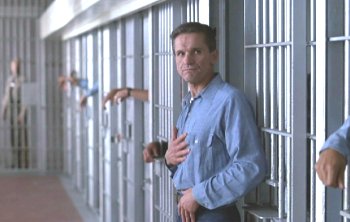

It’s time to put a stop to this silly mobster subplot, now that they’ve wrung enough action sequences out of it. Harry pays a visit to San Quentin, running through a lengthy scene where he convinces generic Janero to leave him alone – under the usual prison threat of fatal butt rampage. For a 91 minute movie, there’s a reasonably amount of filler here.

We have to rejoin Swan’s shooting of Hotel Satan, to remind us this is the central plot here, and to impress just how crummy this whole operation is. (And to set up a great big freaking movie prop harpoon for later…) Oddly, Guns ‘n’ Roses are actually all here, Slash firing said harpoon. What the hell sort of slasher movie was this supposed to be?

Likewise, our Dead Pool Killer (body count so far – one) needs to earn his rep, halfway through this rather stagnant serial killer movie. So he goes ahead and murders that movie critic wench, in pure horror movie style. This is too beyond the pale for an action picture, so we cut away…


- to Donnelly watching a collection of Swan’s “films,” all the hardened cops wincing in girlish terror at the stage blood on display (way to oversell your anti-horror movie agenda, violent action movie). These clips, by the way, include Cujo, It’s Alive III, and Phantasm (which surely doesn’t deserve such disrespect). Donnelly insists to Harry that therefore Swan must be the killer, so – What damn sort of investigation is this supposed to be?! Go and question Swan already!

Nope, here comes another non sequitur distraction, as some jerk has amassed a crowd as he threatens himself with a road flare (before a church, because subtle symbolism is a lost art form). Said jerk, Gus Wheeler, is a crewmember on future classic Hotel Satan, and apparently these semi-connected deaths are so much he’s been driven over the edge! He ain’t the killer, by the way, so don’t get your hopes up. Anyway, he wants attention, wants to be on the evening news for a fiery suicide. Samantha is here, and she makes the “tough” choice not to broadcast this man’s gory self-immolation live on television. Ooh, character development! Then Harry saves the guy, ‘cause that’s what he does, but not until after he’s been set on fire, ‘cause you don’t set up something like that and not follow through.

An elderly tennis player strolls out of his house. I know he’s a tennis player ‘cause dumb movies have lead me to believe they always carry a tennis racket in their hands; I know he’s elderly ‘cause he’s elderly. He goes into a car, then a tiny remote controlled car drives underneath his (killer nearby operating it). Everything explodes.

Okay, the RC car thing is silly; it’s also the most memorable thing in this film – and there’s more of it to come…

Around now we start to learn the Dead Pool Killer is trying to frame Swan for his crimes, using the same victims on Swan’s recreational Dead Pool list. Of course, he forgot one little thing – alibis. Such as dozens of people around him during both of the past two killings. The news informs our killer buddy how Harry acquitted Swan (‘cause no other cop in this universe is that competent). Dwelling in his lair, the killer thrashes all about in a rage, angry over how stupidly ineffective his master plan was.


Harry jogs along the bay when he has another random run-in with the mob – I thought they’d dropped this silly thread. No matter, it’s a chance to see Harry punch men a little (no shootings this time, ‘cause Harry’s body count is already astronomically higher than the “bad guy”). It ends with the two thugs saying Janero sent them to be Harry’s bodyguards. And that’s the last we’ll ever see of them. Well, that was useless.

Movie nearing its end, it’s about time for Swan to reveal to Harry the one bit of info he’ll need so this investigation can start – the killer is Swan’s celebrity stalker, Harlan Rook (David Hunt, still not seen yet). That’s the sort of thing Harry should learn in the first half hour, not the last. And now Harry’s name has been added to Rook’s (but not Swan’s) death list – so that’s why they set up Harry as a celebrity.

Oh well, so he’ll go right after Rook now, right? Nope! Harry goes and has off screen sex with Samantha instead. That’s right, they gotta juggle an unrelated subplot too.


Harry drives off with Quan when Rook gives pursuit in his own car, somehow managing to control another explosive Associated RC 10 ahead of him. Harry sees the RC, and the chase is off – a chase which somehow manages to out-silly the ice cream motorcycle/retirement van chase from Sudden Impact. Harry speeds away from a (surprisingly fast) RC car all throughout the streets of San Francisco, Rook’s car following along in the rear. It’s supposed to be a spoof of Bullitt, which a Dirty Harry movie shouldn’t be doing in the first place, and which isn’t done right anyway. And in a genre that highlights the tireless efforts of stuntmen, behold the artistry of world-champion radio control driver “Jammin’” Jay Halsey! Oy. This is pretty rigoddamnridiculous!

Finally the dinky little RC car (so unintimidating the sound effects guys had to add a growling engine) has Harry cornered. Then Harry figures out the answer – just reverse a little. Thus the C4 RC only ka-booms Harry’s front engine (oh, and Quan’s torso too).

(Quan’s okay, despite all genre dictates that say the ethnic partner always dies. Astoundingly, this is the only Dirty Harry movie apart from Dirty Harry where the partner isn’t killed.)

Okay, so now Harry can barge in on Rook’s hideout – merely some normal San Francisco apartment, full of horror movie posters. Ooh, he likes horror movies – he’s evil! Of course Rook isn’t there, masturbating in his own scat or whatever it is celebrity stalkers do in their off time – ‘cause it isn’t Rook’s off time. He’s gone right ahead and added Samantha’s name to his Dead Pool list, ‘cause to hell with the original intent or premise or motive or anything, and he’s off to nab her and act crazy in front of her.

Rook (still not revealed by face) kills Samantha’s poor dumbass cameraman (who was on no one’s lists), and hauls her off to the abandoned meat locker movie set. (Ah, action sequence potential, that’s why there were filming in a meat locker!) Harry (and only Harry) figures this all out, so he shows up soon enough for the classic hostage scenario movie climax. (So common again by 1988 that Die Hard, forever my yardstick, was already inverting this situation.) Okay, so Rook has a knife; Harry has a .44 Magnum. Who’s got the upper hand here? Well, Rook, ‘cause the villain has to in the climax – somehow. Then he gets his fool hands on Harry’s Magnum, and chases Harry all throughout whilst firing off with typical imprecision. (I mean, a dozen mobsters per entry cannot kill Harry, what chance does a schizophrenic fanboy who thinks Liam Neeson is stealing his dreams stand?)


So it makes sense why Rook cannot hit the broad side of a barn, leaving me to wonder why he’s the ultimate villain in the final Dirty Harry picture. And with the Magnum now empty, Harry can emerge from the cinematic steam clutching the freaking harpoon gun! “You’re shit out of luck.” Harry fires the goddamn huge-ass PROP harpoon through Rook’s stupid chest, recreating a scene from Hotel Satan in a “clever” moment. And now the cops arrive instantly. Ending the film, Donnelly asks where Rook is, and Harry says he’s “hanging out back there.” Oh god, a James Bond pun!

So this is ultimately how Dirty Harry ends – mired in the morass of late ‘80s, pre-Die Hard action, the sort of thing which directly led to the creation of Last Action Hero. You know, for how influential all these Harry movies are, I’m afraid that is the legacy of The Dead Pool – that, and the whole SOL thing. This is the sort of pure formula dilution one connects with Roger Moore or the Schumacher Batman movies. The box office somewhat reflects that, with The Dead Pool being the second least successful Dirty Harry movie (somehow, Dirty Harry itself remains at the back of the pack, even though it’s a stone cold classic).

Clint Eastwood was sure as well not making any more Dirty Harry movies, seeing as this was a favor from Warner Brothers to finance his ongoing artistic ambitions. And four years later, Best Picture Unforgiven handsomely proved how Eastwood was in an entirely new phase of his career. And only the most myopic movie fans would sincerely lament Eastwood’s evolution from action potboilers to excellent dramas.

Still, because The Dead Pool is stupid, there remain occasional mutterings about resurrecting the Dirty Harry franchise. In a world with Live Free and Die Hard, Rambo, Rocky Balboa, surely this doesn’t seem like too much of a bizarre stretch to some – and a recent fervor for serious, gritty reboots means another Harry could even be done well. But some people forget, we’ve sort of had our sixth Dirty Harry movie, unofficially, in Gran Turino, which even saw the likely last time Clint himself will ever perform. Barring a remake starring someone like Hugh Jackman (unlikely – we’ve evolved from making remakes of '70s movies, to making remakes of ‘80s movies), Dirty Harry is out to pasture, but a single chapter in the mighty and ongoing career of cinematic legend Clint Eastwood.

But it is Eastwood himself who should be given final word:
Dirty Harry VI! Harry is retired. He's standing in a stream, fly-fishing. He gets tired of using the pole – and BA-BOOM! Or Harry is retired, and he catches bad guys with his walker? Maybe he owns a tavern. These guys come in and they won't pay their tab, so Harry reaches below the bar. ‘Hey guys, the next shot's on me.’”


Related posts:
• No. 1 Dirty Harry (1971)
• No. 2 Magnum Force (1973)
• No. 3 The Enforcer (1976)
• No. 4 Sudden Impact (1983)

Dirty Harry, No. 4 - Sudden Impact (1983)


Normally, it’s a sign to start worrying when an actor takes over directing his own franchise. Consider Sylvester Stalone’s input for both Rocky and Rambo. Of course there are always exceptions to the rule, actor-directors who prove this hyphenate is something more than just a heightened chance at the actor-driven Oscars – and the greatest exception is Clint Eastwood. For as much as I spoke in glowing terms earlier of Clint the actor, so I must now speak in glowing terms of Eastwood the director. For here we have an artist, truly, an entirely self-assured and stately storyteller, endlessly furthering career-wide themes of masculinity and violence.

Naturally, such commentary must mean that today’s subject, Sudden Impact, is the work of Eastwood the director even while it is a Clint starring vehicle. Even by 1983, Eastwood was a mightily accomplished director – he was even before Dirty Harry was made, with the atypical Hitchcock homage Play Misty For Me. And once Sudden Impact was on the scene, Eastwood had at least one true classic under his directorial belt – The Outlaw Josey Wales (I could hear an argument for High Plains Drifter too). So really, in a remarkably skilled career that would go on to create Unforgiven, Mystic River, Million Dollar Baby and Letters From Iwo Jima, there is as much reason to consider Sudden Impact in that context as it does to think of it simply as the fourth Dirty Harry movie.

Of course the franchise was good and seven years dead in 1983, with no immediate plans for resurrection. But then Warner Brothers, understanding the new decade’s sudden deadly case of sequelitis, performed an audience poll to test the waters for a fourth Harry. The response was overwhelmingly positive, and thus a movie was put into production, with Eastwood at the helm as actor, director, producer and possibly gaffer (he wasn’t yet up to scoring his films by then). The result, from a Joseph C. Stinson screenplay, is a ridiculously mixed film. At times, this is a serious and mature movie that returns the franchise to its 1971 roots, and then some, with grit and verve to match a new examination of vigilante justice. At other times, it is the same stupidly violent action flick that was exemplified by The Enforcer – which dared ask the eternal question, “Hippies, should we kill them?” It’s sort of the same mixed-bag issue as with Magnum Force, but with the added element that director Eastwood’s particular hang-ups are present as well – I’d almost say it’s better than Magnum Force…almost.


It is dusk on the furthest seaside outskirts of San Francisco, and a couple is going at it in a car. Eastwood’s exceedingly dark, noir-tinted imagery, and Lalo Schifrin’s equally moody musical funkadaciousness, clue us in that things are not as they should be. Indeed, soon enough the female participant produces a handgun, and performs what a crime scene investigator later tactfully refers to as “a .38 vasectomy.” One, yee-ouch!, and two, I’m amazed by how tasteful Eastwood is able to make such an act. Compare it to the opening of the dreaded Ilsa.

Our reintroduction to Clint’s Harry Callahan happens in court, Harry wearing The Terminator’s Gargoyle sunglasses indoors. Ah, whatever, Harry’s enough of a badass to get away with both this and hideous tweed jackets. In a regrettably familiar moment, a sickly liberal judge tosses out a case of murder due to Harry’s police work by way of Tyrannosaurus. A trio of tittering, vapid thugs, truly three punks, is nearly Scott free when Harry harasses them in the elevator.


All this is a perfectly adequate intro to Harry Callahan, but it’d only really be enough if we saw Harry blasting punks away with his noble Magnum. It’ll have to be several different punks, so it’s off to the local diner for Harry. Here said punks are enacting an early version of Pulp Fiction’s opening (later scenes obviously inspired Kill Bill), robbing the diner. Harry has them clearly outmanned, with “Smith, Wesson and me.” He blows most of them straight to Inferno, but he has something even better in mind for the last punk – one of the absolute greatest movie lines of all time:

“Go ahead, make my day.”


This line is noteworthy enough to have its own Wikipedia page, and all this in a movie most people don’t even remember. It’s kind of amazing, actually, with so many “Yippee kay-yays” and “I’ll be backs,” how Harry’s never reused a one-liner across films…He does have, ostensibly, another notable line in here: Following any setback, Harry says “Swell.” Yeah.

Such openings are typical Harry fare, and they needn’t have any connection to the plot. Harry’s next seemingly isolated act of badassery, however, does jumpstart the plot – well, the stupid plot, the one not having to do with the murdered groin. See, Harry pays a visit to nebulous mob boss Threlkis (Michael V. Gazzo, The Godfather Part II’s Frank Pentangeli) at his granddaughter’s wedding reception. Harry issues various hoarsely-uttered threats, prompting Threlkis to go ahead and have a deadly heart attack right there beside his just-married granddaughter. Ha HA, the mere thought of Harry Callahan kills mobsters dead! This justifies the random action sequences to come, as Threlkis’ mob thugs (a different form of lowlife than punks) will make the occasional abortive attempts on Harry’s life – and themselves die en masse for their trouble.

It also more immediately earns Harry a trademark chewing out from his latest pigheaded supervisor (split between Bradford Dillman’s Captain Briggs and Michael Currie’s Lt. Donnelly, because no one man can hope to control Harry Callahan). Because firing or killing Harry isn’t an option, these exasperated politician policemen simply suggest Harry take a vacation.

Reiterating the return of a hardboiled, non-comic booky Harry, here’s a speech he gives reiterating his own sense of justice:
“No, this stuff isn’t getting’ to me. The knifings, the beatings, old ladies being bashed in the head for their Social Security checks, teachers being thrown out of a fourth-floor window because they don’t give As, that doesn’t bother me a bit. Or this job either. Having to wade through the scum of the city, being swept away by bigger and bigger waves of corruption, apathy and red tape. Nah, that doesn’t bother me.”


Meanwhile, we are introduced to Jennifer Spencer, played by regular Eastwood costar and long-term partner (despite her bizarre open marriage to a gay friend) Sondra Locke. We instantly recognize her as the penis-shooter. Given her position at the opening, we would be led to believe she is the villain, but that’s not really the case. The next set of scenes, which see her visiting her comatose, vegetable sister Elizabeth at the hospital, and then revisiting a seaside boardwalk, reveal the real truth: She’s the main character. This may be Clint’s franchise, but it’s Eastwood’s movie, and he’s more concerned with telling Jennifer’s drama than he is in running through the usual Dirty Harry motions with the Threlkis plot.


Jennifer’s visit to the boardwalk of San Paulo (really Santa Cruz, an enclave full of tofu-scrunching neo-hippies and banana slugs) triggers memory flashbacks. It’s now ten years earlier (that is, the year of Magnum Force), as Jennifer relives the combined gang-rape of herself and Elizabeth under the boardwalk. Individual close-ups of the assorted rapists reveal the narrative drive – Sudden Impact is the Dirty Harry variation on those rape-revenge flicks from the late ‘70s grindhouse scene (movies like I Spit on Your Grave and…Dirty Harry’s spiritual brother Death Wish). We’ll be reintroduced to these despicable rapists over the course of the flick, and Jennifer will shoot them all in the penises. And seeing as this is a Clint Eastwood movie (and thus, exploitation aside, forever in the “stately” mode), there is nothing in the repeated gang-rape flashbacks that is overly disturbing content wise, even while the cinematic tricks on display make it far more unpleasant than it would otherwise be.


Harry, meanwhile, has a run-in with three of Threlkis’ hoods while “on vacation” – that is, randomly wandering the seediest of all San Francisco’s docks. He kills them.

Donnelly chews Harry out.

Harry practices in a forested firing range, employing his ultra-special .44 Automag (for when a mere .44 Magnum ain’t awesome enough). Here is his good buddy Horace King – You were waiting for Albert Popwell’s traditional Dirty Harry role? Well, here it is.

Harry then has another nighttime action sequence, of next to no context. See how Harry’s storyline in this thing is rather half-baked? This time it’s punks, not thugs, in the form of those guys who got out of court due to Harry’s mistakes. So trying to murder him makes perfect sense then, I guess. They toss delicious Molotov cocktails, and then, with a single shot of his Magnum, Harry is able to send their car tumbling into the bay. Those of us following the franchise know how this immediately kills bad people.


One predictable chewing out later (How dare Harry defend his own life?!), and Donnelly has put Harry on Double Secret Vacation. Thus Harry shall relocate for the remaining narrative to San Paulo, the hometown of the “cock-shot stiff.” (These cops are all poets to a man.)

The very instant Harry arrives in San Paulo, he sees a typical Harry scenario – a criminal shooting it out with a cop. (I promise this movie gets better in the second half.) Harry instantly gives chase on foot, only the criminal gets his punk hands on – an ice cream motorcycle?! So Harry gives chase in – a retirement community shuttle?! What is this, a Roger Moore movie?! Oh well, I guess it’s been five minutes since an action sequence.


San Paulo’s Chief Jannings (Pat Hingle, Commissioner Gordon) chews Harry out for his audacity in capturing this criminal with zero casualties or even property damage. It must be so nice for Harry to be chewed out in a new location.

It’s time for Harry’s plot and Jennifer’s plot to collide, quite literally, as they run into each other while jogging (courtesy of Harry’s comic relief bulldog – don’t ask). Nothing can come of this now, for they go their separate ways.

As Harry has been sent to San Paulo to investigate George Wilburns’ murder (and only now do we learn the name of the de-penised man), he heads to the local dive bar to examine George’s former rape buddies. (There is a frame photo in the police station essentially rejoicing the entire rape gang, for one of these ne’erdowells is Captain Jannings’ son – which sorta justifies the stubborn pigheadedness of Jannings’ character.) And let me tell you, San Paulo’s beloved rape crew is a tremendously uncouth, loutish pile of boors, unschooled and proud of it – they’re the worst sort of people in the U.S. Amongst these asses is Kruger (Jack Thibeau). More importantly, though, is Ray Parkins (Audrie J. Neenan), who is actually a female, despite all evidence to the contrary, and of nebulous sexual orientation – she’s the one who arranged the rape for her six male buddies. She attempts a come-on to Harry, who rejects her rather decidedly: “Only with humans.” Boo-yah! Oh, and when Harry says George is dead, everybody laughs. These people all deserve to be shot repeatedly in the penises.

It’s taken long enough, but it’s about time for the real revengin’ to get underway – and with that started, this movie can really start to work. Jennifer, after much soul-searching, tails Kruger to the beach and confronts him with her .38. “You don’t remember me, do you?” Then begins the systematic de-penisification of Kruger!


Harry arrives at the beach, easily connecting the MO here with George. Jannings rejects this theory outright, mostly because that’s what supervisors in these movies do.

Ray, that disgusting, chinless, straight bull-dyke redheaded flannel-shirted hillbilly accessory to gang-rape that she is, has also figured out what’s going on. She phones up Las Vegas, getting in touch with the central villainous mastermind – Mick the Rapist (Paul Drake). I’m serious, the credits list this character as “Mick the Rapist,” so much does he self-identify with such a lifestyle. And I mean, really, look at the guy!


It’s nighttime in San Paulo, and Harry encounters Jennifer at a restaurant so that this movie can instigate its central relationship, nearly two thirds in. Dialogue that rather reminds me of hardboiled ‘40s noirs (the cinematography mostly pegs them as the other major inspiration here, along with rape-revenge movies). It becomes clear that Harry and Jennifer share a similar notion of justice and victims’ rights. You see, in this movie Jennifer is the vigilante and, unlike the death squad of Magnum Force, she’s in the right. I mean, she’s doing Darwin’s good work! And here the conflict, at least in Jennifer’s eyes, is that Harry is on to her. That shall come, eventually, but really, this is Jennifer’s story.

Harry returns to his hotel, has an encounter with another mobster, and kills him. This is the sudden end of that whole Threlkis subplot, which has been a bizarre embarrassment this entire time.

It’s time for another revenge groin mauling! This time it’s businessman Eddie, trapped in his garage and shot in both heads. Consider the shot below, and tell me this wouldn’t work better as a B&W 1940s noir piece ala Detour or Double Indemnity.


Mick the Rapist, for all his limited screen time, genuinely comes across as the seediest figure of this franchise since the detestable Scorpio Killer. He shows up at Ray’s front doorstep for an evening of swigging cheap swill, then potential rape (‘cause that’s just what he does). To that second intent, he punches Ray around a little bit. Then Harry Callahan shows up at the front door, so he punches Harry instead. Harry punches Mick. Harry punches Ray. Ray punches Mick. There’s punching all around, in a most satisfying and debased way, and then Harry hauls Mick’s rapist butt off to jail.


Men now gone, Jennifer enters. Ray, ever the world-class vulgarian, says perhaps her cleanest line in the whole movie: “So, the bitch is here. Tell me, how’s your slut sister?” And since Ray doesn’t have a penis (apparently), Jennifer shoots her breasts off, and then her face for good measure. I’d happily suspend biological science just this once to afford Ray a worse death, because she deserved to suffer (by the skewed morals of the rape genre, at least).


Harry meets Jennifer upon the pier, each of them done with their evening’s violent errands. Now, Harry’s had sex before in the franchise, but this is his first romance, and given the themes and emotions, it is decidedly not tacked-on. In fact, this might restore some of Jennifer’s shattered soul, exemplified by her Dorian Gray-esque painting. As a spoiler, she shall kill no more rapists in this, though that doesn’t keep Harry from committing many, many more murders.

Meanwhile, Mick the Rapist has been sprung from prison, presumably under Jannings’ wrongheaded desire to never punish any criminals. He then proceeds to Harry’s motel, intent upon his own rampage of viciousness (and possibly rape). Here is Horace, for no other reason than to satisfy the “black guy dies in a movie” trope. Mick the Rapist kills him. (By now, two randomly murder-happy thugs are in tow.)

Then they find Harry anyway, beat him mercilessly, toss his Magnum into the ocean, and dump Harry off the boardwalk. Hitting water, we’ve seen, is fatal to villains; with Harry, it just makes him mad!

Jennifer is back out running errands, and has gone to Jannings’ house to kill his son Alby. She hesitates when she discovers Alby is as much a vegetable as her own sister; Jannings explains how this came as a result of Alby’s guilt over the rape, and Jannings’ subsequent cover-up. (Nice town!) And here is Mick the Rapist, who has been actively blackmailing Jannings all this time. He takes Jennifer’s .38, and outright murders Jannings because, well, these movies have a quota to meet. “Don’t sweat it, it’s a freebie.”


Mick the Rapist and gang lug Jennifer below the nearby dock, and I needn’t say what they have in mind. Jennifer taunts Mick and his penis: “You’ll have to rape my dead body.” My goodness, this movie is dark in both tone and cinematography! It’s almost too much to bear, except for my undying faith in Eastwood. For throughout the movie, it’s somehow never exploitative.

Jennifer escapes, entirely of her own accord, and flees to the boardwalk’s carousel. Eastwood is in pure Hitchcockian mode, like 1/5th of all his films, and so this is a natural place for a modern (or ‘80s) reenactment of Strangers on a Train’s climactic scene. The lighting is down to the barest minimum that will still allow for legibility, which, combined with the carousel’s wild spinning, renders the scene either very effective or very distancing, depending upon the viewer. Screen caps are impossible here, as much as I’d like to.

The rapists chase Jennifer outside. They have her cornered when –


Yes. Yes! YES! It’s Harry, doing a dry run for Unforgiven! Really, this is the closest a Dirty Harry movie has come to being a western, .44 Automat replacing a Colt six shooter. If I had to pick a single best moment for the franchise, this might actually be it! (Eastwood is clearly doing his best Leone, which instantly wins me over – I love a western.)

The first two rapists prove nothing for Harry’s phallus gun, but Mick the Capitalized Rapist is another matter. He takes Jennifer hostage, much as Scorpio did that kid at Dirty Harry’s end, and Harry repeats his best entry one-liner, much as at Dirty Harry’s end: “Go ahead, make my day.” It bears repeating…“Go ahead, make my day.” So Harry shoots Mick (the Rapist). Many, many times. But that’s not enough, oh Lordie no! Mick falls off of the rollercoaster (he was on a rollercoaster, by the way), and impales upon a carousel unicorn! Paging Dr. Freud.

There’s one final strand to cover: Jennifer’s murder spree. Considering the police (who have conveniently waited until after the climax to show) have found the .38 on the Rapist’s body, it’s simple enough for Harry to peg the spree on him, writing Jennifer a clean ticket. That’s a rather nice ending (astoundingly, the happiest in this franchise), and smacks of as much redemption as most rape-revenge movies are capable of.

What fascinates me about Sudden Impact, in Eastwood terms, is how (as said) it rather predicts Unforgiven. We have the same aging iconic figure, the same questioning of violence for revenge, and the same sexual assault to kick things off. Given the later western, it’s clear a great movie could be made from these trappings – sadly, Sudden Impact is not that movie. Perhaps it was too early in Eastwood’s career to handle such weighty material, perhaps Clint the actor wasn’t quite old enough to function as he did in Unforgiven (Clint already has Peoples’ script to that film by 1983, and was nursing it until the right age). Perhaps as the fourth entry in a franchise, it is the wrong place to suddenly force such weighty matters upon the audience. It’s clear the movie, as a Dirty Harry picture, cannot entirely sustain the idea, hence all those weightless confrontations with thugs and punks. Still, viewing it as more than a Harry movie helps to improve one’s enjoyment.

Enjoying Sudden Impact never seems to be a humongous problem – yet again, this was the highest grossing Dirty Harry movie of them all, even after each movie before it had reached this plateau. This is something fairly unheard of, a franchise that can so consistently improve its box office time and again. (It’s not entirely rare, for offhand I can think of James Bond and Toy Story doing the same thing.) And while the other three movies each had an amount of influence on the nascent action genre, Sudden Impact had more – it is the opening act for all those gloriously cheesy ‘80s action flicks to directly follow. That, along with the notable maturity, suggests the Dirty Harry franchise had run its natural course. But there was still one more to come…


Related posts:
• No. 1 Dirty Harry (1971)
• No. 2 Magnum Force (1973)
• No. 3 The Enforcer (1976)
• No. 5 The Dead Pool (1988)

Dirty Harry , No. 3 - The Enforcer (1976)


The 1970s were a good time for movies, but not a good time for franchises. These things just weren’t made, not with the reckless abandon of the ‘30s and ‘40s, or of the ‘80s and every time thereafter. Let us consider why. The Golden Age of Sequels (and also Hollywood, for what it’s worth) was defined by a divide between A- and B-pictures…Most of the sequels and franchises occurred within the B-realm, unconcerned with excess artistry or even box office beyond mere profitability and perpetuity. But when the studio system collapsed, aided by World War II and television, Bs ceased to be at the major studios – Hence the mini-majors, the semi-independents such as Roger Corman would come to represent took up the B-slack from the ‘50s onwards. But they were mostly unconcerned with sequels, typically following brief cinematic trends (biker movies, women in prison movies, etc.) rather than specific continuities. And within the major studios, big money was mostly spent on “important” dramas, A-material likely to give off the impression of pedigree – you know, literary adaptations, critic wanks and the such. And with the B-masters largely eschewing sequels, the big boy studios would themselves only pursue one if there was a particular viability to it.

Thus, even while Dirty Harry’s first sequel, Magnum Force, was both hugely successful financially, and an artistically noteworthy sequel (though falling short of the original’s iconography), it seems no third Dirty Harry picture was immediately envisioned. There was no necessary place to go with this narrative, as Dirty Harry had opened a controversial wound re: vigilantism, and Magnum Force had closed it, or at least presented the flipside argument. From the position of this franchise “meaning something,” it was done – even though cop movies are one of the most endlessly recyclable premises on Mother Earth.

A three year gap separates Magnum Force from its follow up. I cannot say with certainty what the studio plans were, but the fact is that the eventual project was given momentum by two outsider writers working on a spec script. Gail Morgan and S.W. Schurr developed Moving Target as a Dirty Harry picture, simply because they themselves were fans and wanted to see another one (and didn’t have the Internet to satiate their fetish). This script found its unerring way to Clint Eastwood’s favorite restaurant in Carmel (where he’d eventually become mayor), and it impressed Clint so much that he had two real Hollywood script doctors go to town on it – so that the final screenplay for The Enforcer (renamed in order to rip off Humphrey Bogart) belongs to Sterling Silliphant and Dean Reisner, those other two guys getting story credit. We’re a long way from John Milius and the other astounding writers who contributed to the first two, I tell you what.

And that’s the thing, given The Enforcer’s background: It is a generic Dirty Harry sequel, even though a generic Dirty Harry movie has more on its mind than your average actioner. Sadly, it does not have a cohesive thought, as rather its multitudinous screenwriters pursued different threads. The final film sees, almost wholly unincorporated, the villains on one side, Harry’s latest partner on the other, and a whole lack of momentum connecting them.

Continuing an almost imperceptible slide in franchise value, the director has been reduced to James Fargo, otherwise best known for Every Which Way But Loose, where he costarred Eastwood with an orangutan (and presumably, the orangutan’s trainer got paid more than Clint did). The result is a movie that lacks the gritty verisimilitude of Don Siegel and Ted Post (and also replaces Lalo Schifrin’s funky nonsense with an orchestra). It’s frustrating in this way, as the result is somewhat flat – never bad, never remotely inept, just remarkably uninspired and rote.

One question that must be answered when developing a context-free Dirty Harry sequel from scratch is “Who’s the bad guy?” Well, lucky for the series, it’s set in contemporary 1970s San Francisco crazy town – just wait a few years, and a loco new fruitcake villain emerges in real life so your movie can make the ersatz version. Because surely the Zodiac Killer was all about furthering Clint Eastwood’s career! And now that it’s 1976, here’s out latest band of murderous nutjob Bay Area assholes – The Symbionese Liberation Front! No, not the radical groups from Life of Brian, the new left commie militant hippie jerks who kidnapped and brainwashed Patty Hearst (back then, millionaire heiresses were interesting), robbed a few banks, and proved generally incompetent. When The Enforcer was put out, these maniacs had already been easily foiled by the FBI. It’s a potentially interesting villain idea, but it surely doesn’t hold a candle to the still-nebulous Zodiac Killer; unlike Dirty Harry, The Enforcer has to give its baddies a cinematic upgrade to make ‘em sufficient adversaries for our beloved Harry Callahan.


Things open with a Patty Hearst wannabe hitchhiker luring two gas men to an isolated cabin, where Bobby Maxwell (DeVeren Bookwalter), head of the People’s Revolutionary Strike Force (the PRSF™), gives ‘em respectively a healthy gutting and shotgun to the torso. Okay then, our villainous Mystery, Inc. group is established, making those two 7murders more for our sake than for any in-story reason. (The PRSF wanted a gas truck, and surely when you want something like that, you kill people!)


Going to a bright and over-lit (but still location shot) San Francisco, Inspector Harry Callahan (The Man With No Name) rides along with partner Frank DiGeorgio (John Mitchum, Robert’s brother and reoccurring series character up ‘til now – he abetted in the violation of Scorpio’s Fourth Amendment rights). As in the start of all Dirty Harry movies (or all Clint Eastwood movies at all, full stop), the first order of business is reestablishing Clint’s badass credentials, as if there were any question. But that’s what we’re here for! This must be done through a sudden, quick and plot-independent crisis, in this case a liquor store hostage scenario. Pretty much the exact same thing happened a third of the way through Magnum Force, except…that was a swap meet. Okay, then, it’s different!

We know how this goes: Harry goes in (crashing his sedan through the glass storefront), and shoots several young punks dead with his dear .44 Magnum. Showing Harry is capable of occasional mercy, he merely shoots one punk’s groin off from behind at the base of a staircase.


Such shenanigans are surely well outside of the realm of real world policing (repeat Nick Angel’s Hot Fuzz mantra about “incurring considerable amounts of paperwork”), and yet the inevitable chewing out from the police captain seems equally divorced from reality. Behold Captain McKay (Bradford Billman), undoubtedly amongst the most shortsighted and worthless police captains in the history of the genre. I’ve never seen a purer straw man to get us wholly on Harry’s side. Lt. Bressler (Harry Guardino) is also there, having sat out the whole of Magnum Force so that someone in his position could mastermind death squads – but that’s beside the point. Anyway, the gist is that for the next scene (and the next scene only), Harry shall be transferred from Homicide to Personnel. While The Enforcer may be light on the classic Milius one-liners and grit, Harry still gets attitude to spare, most of it aimed directly at McKay: “Personnel? That’s for assholes!”

Here in Personnel, Harry reviews potential applicants for a detective position. Here is where The Enforcer’s central “message” becomes obvious: it shall be tackling feminism. Oh boy!, 1970s feminism, that’s exactly what I want in my Clint Eastwood movies! It’s sadly never as well-developed as the prior vigilantism arguments (possibly because real world gender workplace equality wasn’t fully developed at this point anyway). Harry opposes the hiring of new officers such as Kate Moore (Tyne Daly, of mostly TV and Broadway, and subject of an inexplicable running joke on “The Cleveland Show”) based on general inability to do the job properly – Another grotesque PC straw (wo)man has an Affirmative Action quota to meet, however, and roundly rejects Harry’s criticisms. Who cares if a cop is competent, as long as she has a vagina, is basically the argument here. I have no idea what the movie’s actual stance is here, since it seems to take the feminist POV, then present it so illogically. Oh well, I like Harry.


What’s that? Oh right, the PRSF – our token baddies! This movie, easily the shortest Harry (until The Dead Pool), is reaching nearly a third over, and we’ve hardly set up our ostensible conflict. (Compare that to Scorpio’s efficiency in spurring the SFPD to action almost instantly.) So anyway, here come those various PRSF ruffians, quite resembling the “Venture Brothers” version of “Scooby Doo.” They have used their ill-got gas truck to gain access to a warehouse faclity through a single chain link fence guarded by a lone elderly gateman. (Naturally, Bobby murders the septuagenarian, in a trademark zero-honor backstabbing.) So…these militants have committed three homicides to accomplish the same thing I could do with a trampoline. And all this to gain access to a warehouse full of weapons – okay, putting L.A.W.S. rockets in your villains’ hands makes a little more sense. With those, they’ll be able to act out some sort of evil plan – if ever the movie’d opted to give them a plan.

And here comes DiGeorgio, along with a non-Harry (read: expendable) partner. DiGeorgio corners most of the rather incompetent militants (they ain’t the greatest villains Harry’s ever been up against), and earns a Bobby backstabbing special for his trouble. Upping the body count simply because it’s an action movie’s duty to do so, Bobby shoots the barely-wounded artificial Hearst (bye-bye, sex appeal!), then runs over DiGeorgio’s expendable partner with the gas truck.

DiGeorgio, out of all these people, cannot simply die right away, since he’s a recurring character, and needs a heartfelt deathbed scene with Harry. This is where our hero gets the scant info he needs to start a plotline – DiGeorgio describes Bobby as having, basically, an angel face and a boring name. (Only one of those is true.)

They know Bobby from an old case, prompting Harry to search the old files, prompting idiot McKay to yell at Harry for doing things slightly out of line with his out uniquely particular sense of bureaucracy. McKay is an asshole. Furthermore, he’s a closet racist, as he’s convinced this warehouse job was the work of black militants (read: Black Panther stand-ins, in case the Patty Hearst thing weren’t enough), despite the complete and utter lack of evidence pointing towards them. Since this becomes a major, plot-stalling thread, it’d be nice if there were some further justification for McKay’s sudden crusade against darkie.


Anyway, Harry’s been given a new partner, because three movies in that’s exactly the sort of Hollywood hack plot hook they’re going with now. (It sorta happened in Dirty Harry too, but that was to give us a window into Harry himself, and was never the source of comedy.) I’d give you one guess about Harry’s partner, except I’ve hardly said anything about her so far. Okay, so it’s Kate. Oh ho, Harry with a woman?! Saints preserve me, how mismatched! [Sarcasm.] If the series as a whole is the action genre in utero, here’s where those buddy cop comedies come from. This is how Kate will be used: hammering home the gender equality “message” with substantial lack of subtlety, serving as forehead-slappingly incompetent comic relief, and turning suddenly capable when the Third Act demands it. And this, folks, is why the villains have been shortchanged in this entry! So a Dirty Harry sequel can predict what a Lethal Weapon sequel would do!

Nothing’s progressing on that bad guy front so far, so here comes one of ‘em now to do something with next to zero purpose – blow up an unoccupied police restroom. You know, that doesn’t scare anyone. (Again, I could’ve done the same thing, with a cherry bomb – trampolines and cherry bombs…I could be a Dirty Harry villain!) All this does attract is Harry’s attention, leading to a much-delayed action sequence that can never get out of the lowest gear anyway. Harry chases the bathroom-bombing black man (just like the SLA, the PRSF has a token black guy, even though the real life organization was supposed to be about black people – idiots). So here we have a Dirty Harry foot chase across the rooftops (and genital-packed porno parlors) of San Francisco, played for laughs. Many of these laughs come from Kate, who cannot run in a skirt – Okay, which side is this movie on? And the soundtrack does nothing to aid what little adrenaline there is here, as it’s just big swing jazz noodling.


Ultimately Harry catches the punk, who has just sought out sanctuary in a church. This is a plot point, but the Harry of The Enforcer won’t realize that for another 40 minutes, quite unlike the Harry of Dirty Harry, who caught a serial killer based purely on MO. No matter, the punk perp is identified as a former black militant, which is damn well enough for McKay.


Harry is the first to act on this connection to “Uhuru” (the off brand Black Panthers), as he pays a visit to organization head “Big Ed” Mustapha (Eastwood’s buddy Albert Popwell, who’s role in former Harry flicks include a punk and a pimp – he’s come up in the world). This movie (like the series as a whole) briefly toys with racial issues, then instantly discards them. Then Mustapha, good stoolie that he is, tells Harry he has definite information on the villainous revolutionaries. He won’t tell this info to Harry right now, oh Lord no, ‘cause the movie has a half hour holding pattern in mind for the moment. So no matter, Harry strolls out of Mustapha’s barbershop, and mere moments later McKay and an overcompensating mass of SWAT officers descend upon Mustapha. Somehow with zero evidence, this police captain is able to arrest these heavily-influential black militants with no social repercussions at all!

All this was at the request of the Mayor, mind you. Now, it seems Dirty Harry’s nameless Mayor left town to becomes Dean of Faber College, meaning a totally new nameless Mayor (John Crawford) is in office to enact his mightily ineffective policies. A press conference is held in City Hall, announcing the arrest of Mustapha, Harry’s collar. Yes, here credit is given to Harry (and Kate), for an arrest he had nothing to do with and instantly opposes. McKay and the Mayor are class-A morons! Here is where Harry hands in his badge (‘cause it’s now known this simply happens in cop movies), though it affords Clint a great moment. First he subtly suggests McKay shove it up his ass (“That’s a seven-point suppository, Captain.”), then says things a little more directly when McKay’s limited intellect cannot parse such a one-liner (“I said stick it up your ass!”). It’s a testament to Clint’s star power just how well this moment works, despite how forced they’ve made the captain’s moronical stupidosity.


Harry has a heart-to-heart with Kate, you know, for the “character development.” To this movie’s infinite credit, it has the good sense to avoid a romantic pairing, though it was considered. Nope, they know it’d be forced and unnecessary, and at Clint’s insistence it’d be unrealistic too, considering police professionalism. And oh boy, Kate’s talk about sexual equality just smacks of specific ‘70s rhetoric, ‘cause there’s no better way to espouse ideals than in instantly-outdated speechifying.

But what of those PRSF prats? Who?! Right, the villains. Well now, well under a half hour left, they just go right ahead and kidnap that ineffective Mayor (who’s earned our hatred by ducking out of a Giants game early). This is a chance for the movie to wave about five more deaths before us, including an entirely undeserving bridge operator (these sorts of casualties always bug me in action movies, even while I can watch a cannibal movie without flinching). More importantly, as mere spectacle, it’s a chance for the movie to show us an explosion, in the first (much delayed) usage of a L.A.W.S. rocket. Ka-bangus!


Somehow, this development provokes McKay to go and chew out Harry again, which is merely a ceremonial way of indicating it’s now the Third Act. And Harry’s now a civilian (with a .44 Magnum), so McKay’s directionless rage is stupider than usual. But Harry gets another nice bon mot off on McKay: “Mouthwash ain’t makin’ it.”

In Harry’s mind, the plot cannot progress without Mustapha’s info (‘cause he’s forgotten all about that church), so Harry goes ahead and posts however much Mustapha’s bail is. Then, right away, Mustapha gives him the info he should’ve gotten long ago: there’s a girl called Wanda (presumably a fish too)! Ooh, careful with those bombshells, Enforcer, we don’t wanna excite the audience unduly or anything!

It’s enough, though, for Harry to go on a random sequence of adventures across the city, whatever left-field set pieces they could think of. The first one sees Harry crashing a “massage” parlor, where Wanda used to work as an “escort.” Come for the moment where Clint Eastwood destroys an inflatable sex doll with a cigarette! Then marvel as he pounds the hell out of a mustachioed bouncer with a plunger, extracting the latest information on Wanda’s whereabouts.

That church! Oh man, this could’ve been a 45 minute movie had Harry worked this one out on his own. But no matter, I cannot pay attention to odd plot structuring when Harry Callahan is busy beating information out of a priest in a confessional booth, as the elderly flee for safety. Eastwood movies work best at their brashest, and this is the moment that made Eastwood think The Enforcer would be a decent movie – church beatings! And along comes a shotgun-toting nun (which would make for a great grindhouse flick), sneaking up on Harry as he schools the priest on proper flagellation.


Ker-shoot! Earning her Third Act competence, Kate blows the gun nun away, nunsploitating the pulpit with her brain matter! Whoo, the movie’s gone crazy! And now Wanda’s dead – er, the nun was Wanda. The priest is finally clued in to the violent nature of the bazooka-toting ex-Vietnam hippies he’s been harboring. Therefore he has the information that shall lead Harry to the final violent set piece.

One jump cut later, Harry and Kate take a boat out to Alcatraz Island. This seems a rather impromptu invasion force they’ve assembled, which is perhaps why the logic leading up to this is hidden through the magic of editing. And let’s see here: A hostage held in the prison cells of Alcatraz, San Francisco held hostage with rocket launchers…I’ve seen this movie before! (Yes, no action movie is free of Harry’s influence.)

The first of four remaining PRSF puissants fires at Harry from the guard tower. In response, Harry uses the boat’s water cannon, knocking the Hell Hippie into the bay (as in Magnum Force, we’re asked to believe falling into water is instantly fatal to bad guys). Then he and Kate race around the island for a quick and dirty shootout against Bobby’s forces, in a scene that shouldn’t worry Michael Bay one slight bit.

In the end it must all come down to a showdown between Harry and Bobby, the Mayor proving as useless a hostage as he is a politician. But seeing as this is the 1970s, even the most disposable of entertainments feels the need to spice things up at the end with a little unwarranted tragedy. You know how some formula movies just end happily because it’s the standard; this is the ‘70s flipside. Kate is shot dead, not for any particular dramatic reason or anything, but because it’s “gritty.” (It also “snaps back” continuity in case of another sequel, since Harry just cannot have a partner.) But these academic issues become completely meaningless the instant Clint Eastwood picks up a rocket launcher!


Just to harp on the combined tragedy and idiocy, the final aerial shot moves away from a sullen Harry as McKay’s helicopter converges on the island, issuing a spineless capitulation to Bobby’s demands. However McKay, with his learning disability, found out Bobby was on Alcatraz, I cannot say. And fear not, people who think Clint Eastwood and Alcatraz should be a greater peanut butter and chocolate combo than it was here…Don Siegel would really deliver the goods in three years with Escape from Alcatraz.

The Enforcer is that rare second sequel which did even better box office business than its precedents. This franchise is, monetarily, ever expanding. This is despite the drop in quality, perhaps because The Enforcer is (by ‘70s standards) a happy movie. That year’s Rocky won the Oscar for being “’70s happy” (the hero loses at the end), and 1977’s Star Wars showed just how popular a completely uncynical movie could be. And of course there was Jaws the year before, proving how a B-style exploitation movie could be the new A. It’s no coincidence that all these happier movies would engender franchises, while the excellent but ultra-depressing Chinatown could only fart out one sequel (The Two Jakes) over a decade later. Clearly, something was in the air that would put an end to the non-franchising ways of post-War Hollywood.

Despite this sentiment, it was Clint Eastwood who was damn satisfied in 1976 to leave his Dirty Harry franchise as a trilogy. That must be quite the temptation, for things always seem nice and neat at trilogy level. It’s like the comic rule of three: You’ve shown your idea, variation and counter-variation. Anything else would be mere repetition. And by the third film (obvious here in The Enforcer’s case), the seams almost always start to show. But while the Dirty Harry series is always a guidepost for the action genre, so would its eventual fourth film show off another eventual trend still in its infancy…

The fourth film reboot!


Related posts:
• No. 1 Dirty Harry (1971)
• No. 2 Magnum Force (1973)
• No. 4 Sudden Impact (1983)
• No. 5 The Dead Pool (1988)

Tuesday, August 17, 2010

Dirty Harry, No. 2 - Magnum Force (1973)


This is a fortunate sequel. The detailed preproduction of Dirty Harry meant there was plenty of unused material on tap, all of a high quality, ready to apply towards a sequel. (Consider similarly how half the action sequences in Temple of Doom were meant for Raiders of the Lost Ark.) And for as much as screenwriter John Milius may have influenced the final form of the Harry Callahan character, it is here where Milius’ plot notions really flower, the screenplay only now officially attributed to him (and Michael Cimino, of The Deer Hunter, ‘cause the Dirty Harry movies were never hurting for talent).

Dirty Harry’s wake was dominated by a certain amount of criticism and controversy, equating it with fascism, which delayed the film’s eventual classic status. As such, a sequel would be remiss not to address such matters. Magnum Force effectively flips the argument and message of Dirty Harry, switching from the simplistic “vigilantism good” to an equally simplistic “vigilantism bad.” Well, it’s not so simple, in either case, but that’s the gist of it.

And okay, Magnum Force?! That’s no sequel title. I mean, you’d expect it to be Dirty Harry 2: Dirtier Harry, or something like that. Ah, but the numbered sequel thing wasn’t in place in the seventies – The Godfather: Part II really instigated that particular trick, which was, surprisingly, a method to designate it as a non-cash in sequel (suggesting it’s a real continuation). But still, you’d expect at least Harry’s name in the sequel title, or something, for very few franchises can build upon truly standalone titles. The James Bond films are one of those titles, and they use the iconic PPK as a logo to bypass this issue. The Dirty Harry franchise similarly uses the iconic .44 Magnum – and come on, MAGNUM Force! Still, this title implies we have here a real movie, with its own story, that just happens to be a sequel. And the title even means something – see, there’s this force…of guys…with Magnums.


Director Don Siegel is no longer in the picture, replaced by Ted Post (who directed Clint Eastwood in Hang ‘Em High, and also did Beneath the Planet of the Apes, but I won’t hold that against him). It’s pointless trying to find a better movie on Post’s resume because, like Siegel, this is it. And the directing here is surely serviceable – stylistically, this is very much the same as Dirty Harry – but it all plays as a little more mainstream, with a reduction of urban decay and handheld grittiness.

Known gangster and murderer Ricca (Richard Devon) has just been acquitted of the Scarza murders, and is being ushered past the accumulated reporters through San Francisco’s beautiful City Hall (which you’ve seen at the ending of Raiders). So, right off the bat, we have an invocation of the broken justice system, the same scenario which lent Dirty Harry much of its thematic potency. Let us not think this indicates a retread, for the film is using this similar situation to get to its central reversal.

Ricca and a coterie of criminal chums drive along triumphantly in a black sedan. Eventually they are pulled over by a motorcycle traffic cop, who remains forever unrevealed behind his T-1000 helmet and glasses (‘cause this franchise continues to inspire the greats). Ricca’s cronies crow about how little a traffic cop can do to them – then the cop blows them all away with a Magnum! Hope you enjoyed that fake out with the mob, ‘cause here’s our villain.

(Already they’ve nearly equaled the body count of Dirty Harry. In the end, it will be five times what Dirty Harry could muster, even while individual acts of violence seem lessened in impact. That’s called sequel escalation.)

Harry’s back on the force, despite the ending of Dirty Harry. I can only picture him finagling the bureaucratic process in attempts to get another badge: “Yeah, I tossed the other one into a quarry in metaphorical defiance.” Anyway, Harry is joined by his partner “Early” Earlington Smith (Felton Perry, of television and all the RoboCop movies). To the movie’s temporary detriment, Harry is in stakeout now, not homicide, which raises the ire of his new superior, Lt. Neil Briggs (the ultra-talented Hal Holbrook, who never quite had a signature role). (Lieutenant Bressler from before is nowhere to be seen, which is needed because Briggs’ role is fundamentally different.) Unlike before, in this one Harry is always getting chewed out, which loses its potency. And for the first half of the movie, he’s not even actively investigating these killings. This sounds like a pretty big detriment, considering Dirty Harry’s tight plotting, but the general professionalism on display here does a fair amount to override this.

Harry and Briggs have a little conversation, outlining their relationship. Harry, whom we all know as gun-happy and take-no-prisoners, is contrasted with Briggs, who’s never in his career had to unholster his weapon. In Harry’s estimation, “A man’s gotta know his limitations.”

Stakeout or no, Harry has a mob informant who may be of help, who runs a burger stand at the airport. This seems like a pretty random detour, because it is. Milius’ original script featured very little action (it was a “simple script”), so the majority of the action to be found here is tacked on in the truest sense of it – I’m not sure who the screenwriter (or second unit director) responsible is. Anyway, the real reason Harry’s at the airport is so he can face down some leftfield hijackers on some fictional airline’s plane. This is the equivalent to the bank robbery from the first, and the point where Magnum Force is most purely a retread sequel.

Harry boards the plane clad as a pilot, and makes an effort to maneuver the airplane. One of two unmotivated terrorists is just about clued to Harry’s plan when Harry slams on the brakes, overpowering said mook. He takes the mook’s gun, goes back, and shoots the second thug through a wall. This sequence is far lengthier than my write-up (Magnum Force is perhaps half an hour longer than it should be), but there’s not much to comment on. It works well enough, I guess, but it pales beside the Clint vs. punk stuff from before.


Let’s go back to the police station, and meet the rest of our cast. First up is Charlie McCoy (Mitch Ryan), Harry’s longtime friend who’s experienced recent suicidal tendencies. His dialogue sounds like something Harry would’ve said in the first one, lamenting how the spineless bimbos at the DA regard the thought of “cops killing hoods.”

Down at the firing range are four rookie motorcycle cops (hmm), who all carry Magnums (double hmm), and worship Harry unreservedly (multitudinous hmm). If Harry is a vicious, lawless cop, these guys are viciouser, lawlesser and coppier. They’re also copiers, for they parrot Harry in all they do. Amongst the four, we have leader Davis (David Soul, “Starsky & Hutch”), Grimes (Robert Urich, “S.W.A.T.”), and Sweet (Tim Matheson, http://www.imdb.com/title/tt0077975/ – one of these things is not like the other). Oh yeah, and there’s also Astrachan (Kip Niven), who for some reason doesn’t impress me nearly as much. There is talk of handguns and such, to which end Harry displays his proficiency with the Magnum:


I’ll just go and say it now – these four are our villains, a motorcycle cop death squad meant to rid San Francisco of its criminal element. I mean, the audience (but not Harry, not for another hour) has enough knowledge to piece it together already – it benefits the film’s message if we’re already in on this. And this is also a nice adversary for Harry, as it is clearly something different from old Scorpio. For one, these guys are a direct physical threat to him…perhaps not one-on-one, as rookies, but as a group. (Of course there’s sequel escalation in upping the villain quotient from one to four.) They’re dark shadows of Harry himself – I guess it’s not too original for a sequel to pit our hero against an evil opposite, but we need it to turn the tables on the whole vigilante thing.


It’s time for more vigilante justice to be meted out – now that we’ve prematurely identified the villains, might as well. One of them (only one) rides out to some mobster’s orgytastic pool party overlooking the city. Fans of celebrity nudity, here is an opportunity to see Suzanne Somers’ boobs. Here is also an opportunity to see Suzanne Somers’ boobs get shot up with machine gun fire, because in no time flat the cop has outright massacred the entire assembly dead! Ye gods, man, this scene alone doubles Dirty Harry’s collateral! And foul mobsters or no, I cannot believe that the ditsy, coked-up bimbettes on display here were as deserving of a violent thrashing death as old Fat Tony.

Harry’s storyline refuses to intersect all this rather mindless violence, which is a damn shame. His next scene sees him visiting McCoy’s wife, Carol (Christine White), her children rampaging in the next room over. She makes a pass at Harry, threatening to glom a little needless romance into this all-business franchise, when Early calls Harry up with a distraction. It seems the latest non sequitur action sequence is waiting.

In a situation that’s not entirely clear, a trio of robbers is holding up this chintzy swap meet, Early their hostage – I’ve no idea really when this happened, considering the phone call, but it affords some tense moments with the robber readying to execute Early on account of his being a black man. This is when Harry interrupts, as he’s been watching from behind a one-way mirror (it is a rather odd setup for a shootout). So let’s chalk up three more bodies to the count, though these are Harry’s (mostly), and therefore perfectly legal. Some actual adrenaline threatens to break out, but not too much can happen on that front in 1973. This is the pre-Bruckheimer era…to Magnum Force’s limitless benefit, meaning it gets to have content.

This movie really is just spinning its wheels randomly, waiting for Harry to get involved in the second half. The next sequence is the most completely out-of-place of them all, for it involves no character or plot threads from anyplace else…for a good 10 minutes or so. First up, a high-class prostitute (Margaret Avery, Academy Award nominee – for The Color Purple, fool, not for this) takes a cab ride. Was that sentence exciting? ‘Cause this is like 5 minutes worth of screen time. Then her ferocious pimp appears (Albert Popwell, also the famous “punk” from Dirty Harry), laying down the pimp’s patented slap.

Then, just for the R-rated hell of it, he kills his hooker with drain cleaner. Now, not only is this bit of violence almost totally purposeless in the movie as a whole, but it had tragic real world consequences. Now, Dirty Harry inspired its fair share of copycatting, but that was mostly bungled. This is Magnum Force’s sickening parallel: The Hi-Fi Murders. They would have happened anyway; Magnum Force was just the seasoning. Still, I’m upset that I just went ahead and researched these events, and I advise you not to do the same. It’s just…wrong.


Pimpmobile! That improves my mood! And that shot above happens to contain the highest combination of artistry and pimpmobile. And do you vaguely see that motorcycle cop in the back? That’s right, our murderous pimp buddy is about to become the death squad’s next victim – at the lamentable expense of that lovely pimpmobile’s interior. As much as this particular execution offers no new insight or plot developments, I guess there’s a little moral grayness to the proceedings – now that we’ve seen the pimp is a killer himself. In a sense, that’s more effective than the bland, token mobsters that make up the rest of the victim pool.

For the first time ever we see Harry Callahan’s apartment! Here comes his cute Japanese neighbor Sunny, to answer a question no one ever asked – Is Harry heterosexual? Jeebus, of course he is! Had they not set it in this particular city… Thankfully, this potentially plot-derailing detour only yields a single, steamy, softcore sex scene (featuring far above the daily recommended dosage of Clint Eastwood wrinkles), for it’s time for the movie to get back to its primary interest…

Bloody, context-free executions! Again it’s a mobster, now Lou Guzman, making like Caligula in his penthouse suite that is coincidentally under stakeout. Beholds naked buttocks of every gender! And along comes our beloved Pre-T 1000 motorcycle cop, climbing the building’s stairwell all suspenseful-like. He shoots the nude hedonists as dead as pimps, even prompting the female one to turn into a dummy and tumble off of the building’s balcony!


The motorcycle cop then descends to the building’s parking garage, doffing his helmet and revealing to be…Davis! Oh wait, we’d already figured that out. Moving on, McCoy is entering in his motorcycle uniform, sent here because those stakeout guys saw naked tumbling death. D’oh! And here’s where the death squad officially crosses the line, in case we didn’t count the dozen standers by – Davis executes policeman Charlie McCoy as a “witness.” Then he, acting the cop, corrals the gathering public outside and declares it a crime scene.

It is only now that Harry is asked to rejoin homicide and take part in this plotline – okay, it actually happened before the naked penthouse fiasco, but I felt like talking about that. (It would also otherwise oddly break up the tender Sunny sex.) Harry, being a competent police detective, instantly understands how some of these killings (Ricca and Herr Pimp) must’ve been the work of a traffic cop, but chief investigator Briggs will have none of it (hmm). Rather, Briggs has Harry stakeout (as a detective!) yet another uninspiring mobster – Palancio, he of the dock warehouses, ‘cause you can’t have a police actioner without dock warehouses. Harry rather intentionally blows this stakeout, following Palancio out of his jurisdiction and thoroughly pissing him off. Anything to deter pointless plot detours now that, in the second half, Harry can finally get down to business.


But with Briggs denying Harry the freedom he needs to investigate other cops, Harry will have to do this entirely on his own. This shall be done at the big annual shooting competition, where Davis (above) faces Harry in the final. Davis goes first, on the combat shooting range, getting a perfect score. We know Harry can somehow best perfection, only…he shoots a cop target instead. What may at first seem an uncharacteristic error is really a cunning plan – Harry has sent the villains a message. Nice!


With the competition officially over, Harry asks if he can borrow Davis’ Magnum, ostensibly to test it against his own. Here Harry makes another “mistake,” “missing” one target and sinking the bullet into the rear wall. This is really the opportunity for Harry to return later that night, retrieve Davis’ slug, and compare it to that found in McCoy. And it’s the real McCoy! – Sorry. Of course, Briggs chews Harry out for this latest accusation. And in the years that followed Magnum Force, it’s such a cliché for the superior to chew our hero out, this more than anything helps to blur our attention from the slowly obvious fact – Briggs is masterminding the death squads!

Briggs’ “hunches” (that is, who he wants dead) are driving this investigation, which is why Harry was assigned to Palancio. Well, now Briggs has himself a warrant to “arrest” him, requiring all the cops to head down to the docks. In retrospect, this Palancio sequence is supposed to be the death squad’s next hit, which makes one question why Briggs has so very many other guys head in – in truth, it’s for the action sequence. For Palancio isn’t going quietly, rightly fearing for his life as a minor character in a Dirty Harry film, so he goes out all goons blazing.

Harry is on the front lines, for Briggs’ own inscrutable reasons, Davis and Sweet (two of the death squad, remember) joining him. Thus Sweet is instantly killed in the ensuing shootout, saving Harry the trouble in the upcoming climax. And here we are, a police shootout at the docks, like every cop action movie ever made, though here perhaps the original example. I will say, the action quotient in Magnum Force is much increased, which would appeal it to some. And soon enough, Harry is figuring prominently in the stunt-based action, ghost-riding the hood of Palancio’s car like so many Bay Area idiots after him. Here the franchise continues something that really impresses me – it’s always clearly Clint doing the stunts! See below. And soon enough, Palancio is dead.


Harry walks with Early, revealing how the whole Palancio thing (which resulted in like 7 dead, mind you) was all just a setup to kill off Harry; it was Sweet’s bitter sacrifice. Harry is still in danger, and now Early is too. (Quick, who wants to bet Clint’s black partner will survive the movie?) And so, climax coming up, Harry takes the steer by the reins and…goes home. Sure, it’s what I would do, but I’m lazy!


Here Harry receives an offer of employment from the three remaining death-murderers. Subtext becomes text, them all running through the various arguments on vigilantism that came out in the wake of Dirty Harry. Embedded in here is a line that I would be highly suspicious of, had this movie been made in the ‘00s: “Either you’re for us or you’re against us.” Oh my God, Magnum Force is a metaphor for the war in Iraq! Harry turns down his youthful suitors (“I’m afraid you’ve misjudged me.”) and they ride off into the streets for another rewarding day full of pimp murder.

Climax now further primed, Harry takes matters in hand and…checks his mail. Not so fast! There’s a bomb in the mailbox, set to go off when it’s opened. Harry goes upstairs to get his handy diffusion tools, while – Okay, they’ve set it up that Sunny is collecting Harry’s mail for him, meaning she’s now in imminent danger. And this being the sort of movie it is (a death-happy film made in a cynical era), who wants to bet they’ll sacrifice this token love interest just for the feel-bad hell of it? Actually, you’d lose that bet, for the movie is clever enough to have Harry stop Sunny right in the nick of time. (Early, meanwhile, goes to his house and blows up.) Harry collects the disarmed bomb, all while a mustachioed homosexual shriekingly accuses him of mail fraud, the fruit.

Harry, now officially target numero uno, dials up Briggs for aid. If he knows of Briggs’ involvement in the death squad, he does nothing about it. Rather, Briggs collects Harry in his hideous 1970s sedan (Harry driving), then has Harry at gunpoint. Harry’s omnipotent Magnum is hurled out the window into some neighborhood (where it surely has wild adventures of its own), leaving Harry at a severe disadvantage for the finale. Oh well, Briggs is easy enough to lay unconscious, only here come those three motorcycles of doom. And, well, everyone’s driving right now, and they are in San Francisco, the fictional car chase capital of the world – I’m amazed it took this San Francisco set action movie franchise two entries to do the “San Francisco car chase.” And here it is, neither as good as Bullitt or The Rock, but…not bad.

Of course, it all ends up at the docks – not the same docks, mind you, but the salvage yards now. That means there’s an abandoned battleship for Harry to do final battle on. Of course, he has no weapon (except for an American sedan), but he’ll still manage to take out the three Keystone Kops, one by one. It’s not fair to completely ruin the movie and explain just how, except…I didn’t realize jumping into the bay was instantly fatal. And naturally, at some point Harry gets his hands on a motorcycle, allowing for a bunch of show-offy motorcycle jumps. I’m certain Clint wasn’t involved these stunts (but I can’t rule out Steve McQueen).


In the end, to no one’s surprise (but no one’s displeasure), Harry is triumphant in his recent murder of three police officers. Then Briggs comes to, threatens Harry with a gun, and drives off in the sedan of doom with intent to frame Harry for all the death squadery. Ah, but Harry’s planted his mail bomb in Briggs’ backseat (the car), so Briggs explodes. And this is where we end, right before the lengthy, lengthy trial process that will almost surely tide Harry over for the three years until the next entry.


“A man’s got to know his limitations.”

Dilly-dallying plot aside (and ultra-violence aside, depending on taste), Magnum Force is a wholly excellent sequel, certainly far more so than standard expectations would dictate. I’d assume the ‘70s, before the era of the why-the-hell-not sequel (the ‘80s), were concerned enough with little things like art and drama – a sequel wouldn’t come about unless there was a damn good dramatic need for one. In pitting Harry Callahan against a crew of imitative extremists, they found their reason here. And their reward was a generous box office take, decently ahead of Dirty Harry’s – $44 million, to the first’s $35 million. It really isn’t uncommon to see a monetary uptick in the first sequel, especially when it comes anywhere within spitting difference of the original’s quality. Magnum Force is nowhere near Dirty Harry in iconography or classicism, but it is nearly on par quality-wise. So check it out, everybody – a legitimately decent sequel.


Related posts:
• No. 1 Dirty Harry (1971)
• No. 3 The Enforcer (1976)
• No. 4 Sudden Impact (1983)
• No. 5 The Dead Pool (1988)

LinkWithin